Posts

Showing posts with the label Published

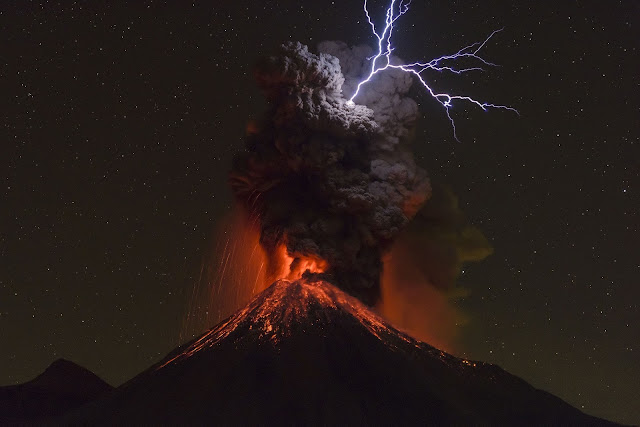
Volcán de Colima Eruption

Image
Colima, Mexico January 26, 2017 Image Credit & Copyright: Sergio Tapiro

Globular Cluster Messier 79

Image
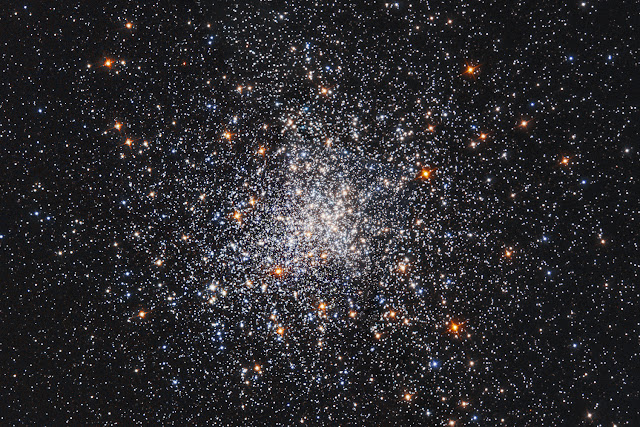
It’s beginning to look a lot like Christmas in this NASA/ESA Hubble Space Telescope image of a blizzard of stars, which resembles a swirling storm in a snow globe. These stars make up the globular cluster Messier 79, located about 40 000 light-years from Earth in the constellation of Lepus (The Hare). Globular clusters are gravitationally bound groupings of up to one million stars. These giant “star globes” contain some of the oldest stars in our galaxy. Messier 79 is no exception; it contains about 150 000 stars, packed into an area measuring just roughly 120 light-years across. This 11.7-billion-year-old star cluster was first discovered by French astronomer Pierre Méchain in 1780. Méchain reported the finding to his colleague Charles Messier, who included it in his catalogue of non-cometary objects: The Messier catalogue. About four years later, using a larger telescope than Messier’s, William Herschel was able to resolve the stars in Messier 79 and described it as a “globular star ...

Spiral Galaxy NGC 1398

Image
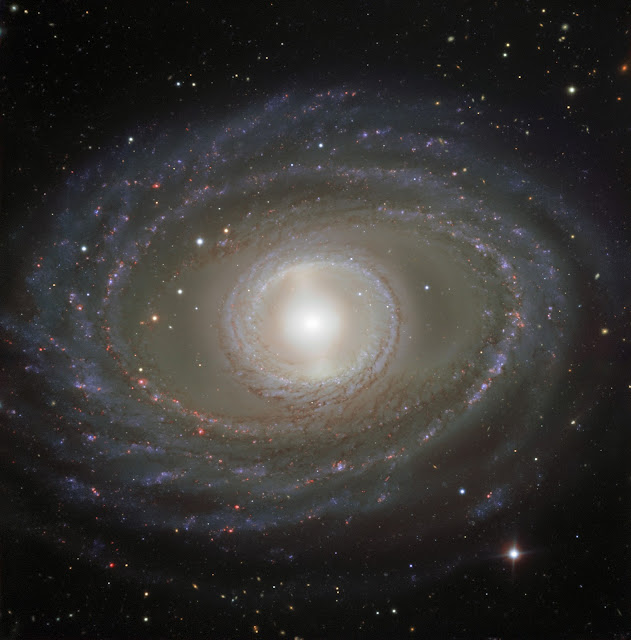
This picture shows spectacular ribbons of gas and dust wrapping around the pearly centre of the barred spiral galaxy NGC 1398. This galaxy is located in the constellation of Fornax (The Furnace), approximately 65 million light-years away. Rather than beginning at the very middle of the galaxy and swirling outwards, NGC 1398’s graceful spiral arms stem from a straight bar, formed of stars, that cuts through the galaxy’s central region. Most spiral galaxies — around two thirds — are observed to have this feature, but it’s not yet clear whether or how these bars affect a galaxy’s behaviour and development. This image comprises data gathered by the FOcal Reducer/low dispersion Spectrograph 2 (FORS2) instrument, mounted on ESO’s Very Large Telescope (VLT) at Paranal Observatory, Chile. It shows NGC 1398 in striking detail, from the dark lanes of dust mottling its spiral arms, through to the pink-hued star-forming regions sprinkled throughout its outer regions. This image was created as part...

The Bluest of Ice

Image
Acquired on November 29 by Operation IceBridge during a flight to Victoria Land, this image shows an iceberg floating in Antarctica's McMurdo Sound. The part of the iceberg below water appears bluest primarily due to blue light from the water in the Sound. The undersides of some icebergs can be eroded away, exposing older, denser, and incredibly blue ice. Erosion can change an iceberg’s shape and cause it to flip, bringing the sculpted blue ice above the water’s surface. The unique step-like shape of this berg—compared to the tabular and more stable berg in the top-right of the image—suggests that it likely rotated sometime after calving. Operation IceBridge—an airborne mission to map polar ice—recently made several flights out of the McMurdo and Amundsen-Scott South Pole stations, giving researchers greater access to the interior of the icy continent. For the ninth year in a row, flights over Antarctica have turned up ample science data, as well as spectacular images. Image Credit...

π1 Gruis

Image
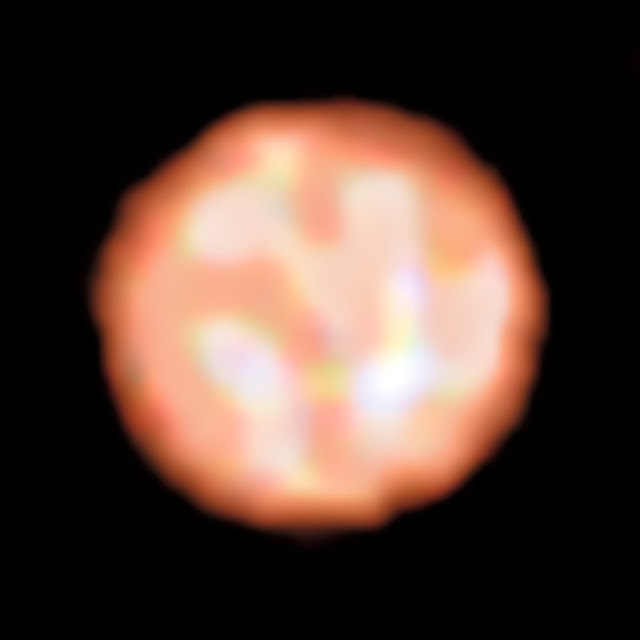
Astronomers using ESO’s Very Large Telescope have for the first time directly observed granulation patterns on the surface of a star outside the Solar System — the ageing red giant π1 Gruis. This remarkable new image from the PIONIER instrument reveals the convective cells that make up the surface of this huge star, which has 350 times the diameter of the Sun. Each cell covers more than a quarter of the star’s diameter and measures about 120 million kilometres across. These new results are being published this week in the journal Nature. Located 530 light-years from Earth in the constellation of Grus (The Crane), π1 Gruis is a cool red giant. It has about the same mass as our Sun, but is 350 times larger and several thousand times as bright. Our Sun will swell to become a similar red giant star in about five billion years. An international team of astronomers led by Claudia Paladini (ESO) used the PIONIER instrument on ESO’s Very Large Telescope to observe π1 Gruis in greater detail th...

Cassiopeia A

Image
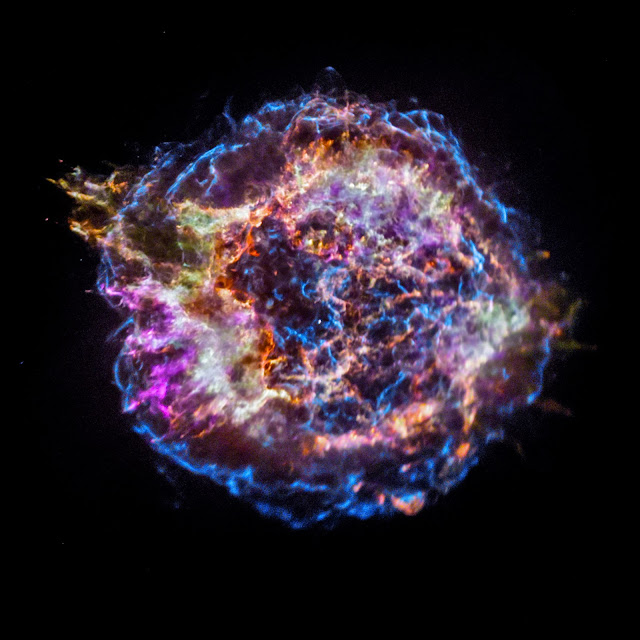
Where do most of the elements essential for life on Earth come from? The answer: inside the furnaces of stars and the explosions that mark the end of some stars’ lives. Astronomers have long studied exploded stars and their remains – known as “supernova remnants” – to better understand exactly how stars produce and then disseminate many of the elements observed on Earth, and in the cosmos at large. Due to its unique evolutionary status, Cassiopeia A (Cas A) is one of the most intensely studied of these supernova remnants. A new image from NASA’s Chandra X-ray Observatory shows the location of different elements in the remains of the explosion: silicon (red), sulfur (yellow), calcium (green) and iron (purple). Each of these elements produces X-rays within narrow energy ranges, allowing maps of their location to be created. The blast wave from the explosion is seen as the blue outer ring. X-ray telescopes such as Chandra are important to study supernova remnants and the elements they pro...

Interacting Galaxy NGC 5256

Image
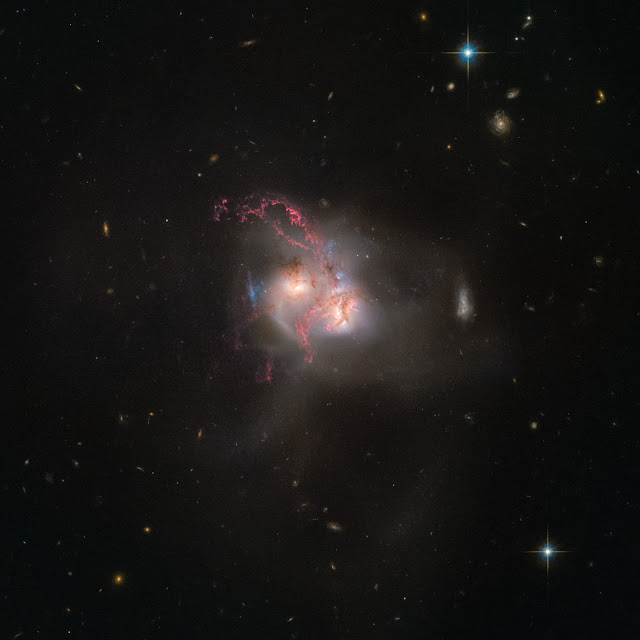
A riot of colour and light dances through this peculiarly shaped galaxy, NGC 5256. Its smoke-like plumes are flung out in all directions and the bright core illuminates the chaotic regions of gas and dust swirling through the galaxy’s centre. Its odd structure is due to the fact that this is not one galaxy, but two — in the process of a galactic collision. NGC 5256, also known as Markarian 266, is about 350 million light-years away from Earth, in the constellation of Ursa Major (The Great Bear). It is composed of two disc galaxies whose nuclei are currently just 13 000 light-years apart. Their constituent gas, dust, and stars are swirling together in a vigorous cosmic blender, igniting newborn stars in bright star formation regions across the galaxy. Interacting galaxies can be found throughout the Universe, producing a variety of intricate structures. Some are quiet, with one galaxy nonchalantly absorbing another. Others are violent and chaotic, switching on quasars, detonating supern...
Mount Agung Volcano

Image
Mount Agung, Bali, Indonesia November 26, 2017 Image Credit: Sonny Tumbelaka/AFP/Getty Images

Lenticular Galaxy NGC 5866

Image
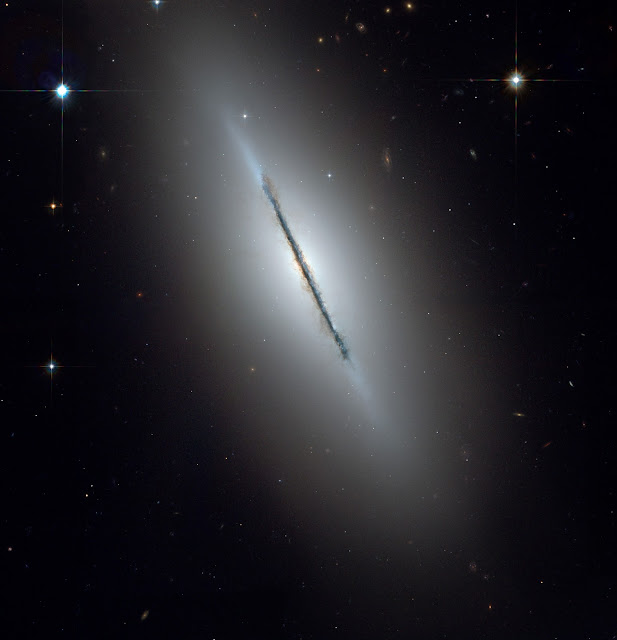
NGC 5866 is an edge-on galaxy that is tilted to our line-of-sight. It is classified as an S0 lenticular, due to its flat stellar disk and large ellipsoidal bulge. NGC 5866 lies in the Northern constellation Draco, at a distance of 44 million light-years (13.5 Megaparsecs). It has a diameter of roughly 60,000 light-years (18,400 parsecs). This Hubble image of NGC 5866 is a combination of blue, green and red observations taken with the Hubble Telescope's Advanced Camera for Surveys in November 2005. Image Credit: NASA, ESA, and The Hubble Heritage Team (STScI/AURA) Explanation from: https://www.spacetelescope.org/images/opo0624b/

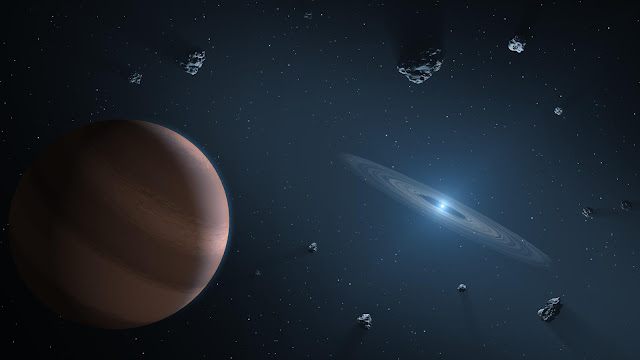
Exoplanet and debris disk orbiting a polluted white dwarf

Image
This artist's concept shows an exoplanet and debris disk orbiting a polluted white dwarf. White dwarfs are dim, dense remnants of stars similar to the Sun that have exhausted their nuclear fuel and blown off their outer layers. By "pollution," astronomers mean heavy elements invading the photospheres -- the outer atmospheres -- of these stars. The leading explanation is that exoplanets could push small rocky bodies toward the star, whose powerful gravity would pulverize them into dust. That dust, containing heavy elements from the torn-apart body, would then fall on the star. Image Credit: NASA/JPL-Caltech Explanation from: https://photojournal.jpl.nasa.gov/catalog/PIA22084

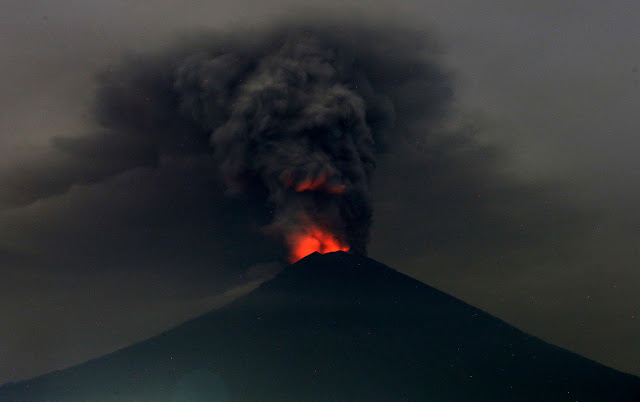
Mount Agung Volcano Eruption

Image
Mount Agung, Bali, Indonesia November 27, 2017 Image Credit: Firdia Lisnawati/AP

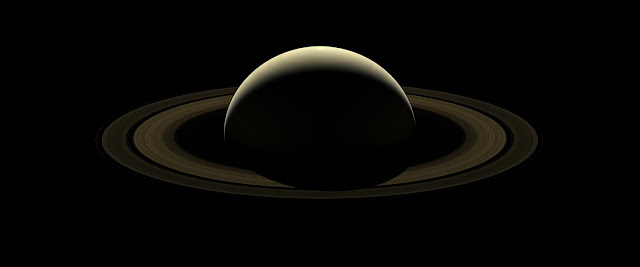
Saturn

Image
After more than 13 years at Saturn, and with its fate sealed, NASA's Cassini spacecraft bid farewell to the Saturnian system by firing the shutters of its wide-angle camera and capturing this last, full mosaic of Saturn and its rings two days before the spacecraft's dramatic plunge into the planet's atmosphere. During the observation, a total of 80 wide-angle images were acquired in just over two hours. This view is constructed from 42 of those wide-angle shots, taken using the red, green and blue spectral filters, combined and mosaicked together to create a natural-color view. Six of Saturn's moons -- Enceladus, Epimetheus, Janus, Mimas, Pandora and Prometheus -- make a faint appearance in this image. (Numerous stars are also visible in the background.) A second version of the mosaic is provided in which the planet and its rings have been brightened, with the fainter regions brightened by a greater amount. (The moons and stars have also been brightened by a factor of 1...

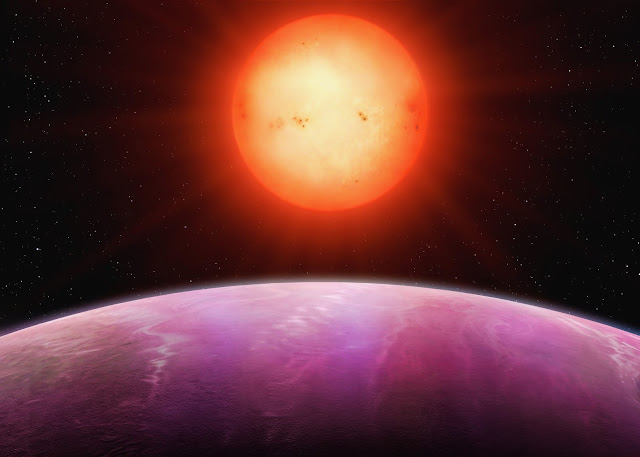
Exoplanet NGTS-1b

Image
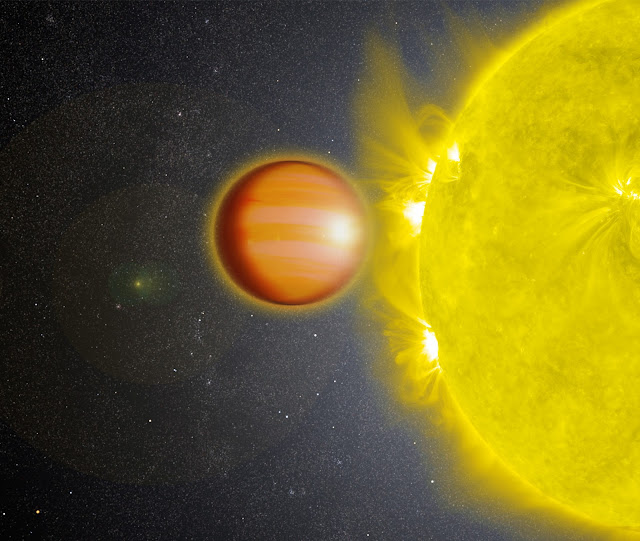
The Next Generation Transit Survey (NGTS) instrument at ESO’s Paranal Observatory in northern Chile has found its first exoplanet, a hot Jupiter orbiting an M-dwarf star now named NGTS-1. The planet, NGTS-1b, is only the third gas giant to have been observed transiting an M-dwarf star, following Kepler-45b and HATS-6b. NGTS-1b is the largest and most massive of these three, with a radius of 130% and a mass of 80% those of Jupiter. The NGTS uses an array of twelve 20-centimetre telescopes to search for the tiny dips in the brightness of a star caused when a planet in orbit around it passes in front of it (“transits”) and blocks some of its light. Once NGTS-1b had been discovered its existence was confirmed by follow-up observations at ESO’s La Silla Observatory: photometric observations with EulerCam on the 1.2-metre Swiss Leonhard Euler Telescope; and spectroscopic investigations with the HARPS instrument on ESO’s 3.6-metre telescope. Small planets are relatively common around M-dwarf ...

Galaxy Cluster Abell 2537

Image
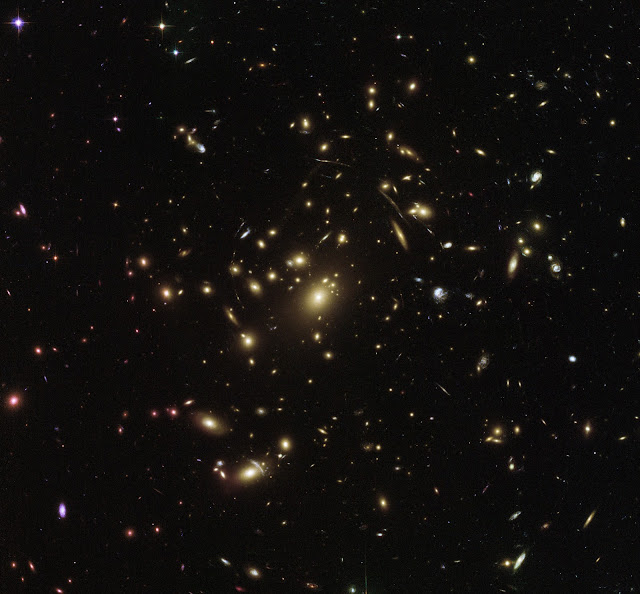
This picturesque view from the NASA/ESA Hubble Space Telescope peers into the distant Universe to reveal a galaxy cluster called Abell 2537. Galaxy clusters such as this one contain thousands of galaxies of all ages, shapes and sizes, together totalling a mass thousands of times greater than that of the Milky Way. These groupings of galaxies are colossal — they are the largest structures in the Universe to be held together by their own gravity. Clusters are useful in probing mysterious cosmic phenomena like dark matter and dark energy, the latter of which is thought to define the geometry of the entire Universe. There is so much matter stuffed into a cluster like Abell 2537 that its gravity has visible effects on its surroundings. Abell 2537’s gravity warps the very structure of its environment (spacetime), causing light to travel along distorted paths through space. This phenomenon can produce a magnifying effect, allowing us to see objects that lie behind the cluster and are thus oth...

Jupiter's Clouds

Image
See Jovian clouds in striking shades of blue in this new view taken by NASA's Juno spacecraft. The Juno spacecraft captured this image when the spacecraft was only 11,747 miles (18,906 kilometers) from the tops of Jupiter's clouds -- that's roughly as far as the distance between New York City and Perth, Australia. The color-enhanced image, which captures a cloud system in Jupiter's northern hemisphere, was taken on Oct. 24, 2017 at 10:24 a.m. PDT (1:24 p.m. EDT) when Juno was at a latitude of 57.57 degrees (nearly three-fifths of the way from Jupiter's equator to its north pole) and performing its ninth close flyby of the gas giant planet. The spatial scale in this image is 7.75 miles/pixel (12.5 kilometers/pixel). Because of the Juno-Jupiter-Sun angle when the spacecraft captured this image, the higher-altitude clouds can be seen casting shadows on their surroundings. The behavior is most easily observable in the whitest regions in the image, but also in a few isol...

Exoplanet WASP-18b

Image
A NASA-led team has found evidence that the oversized planet WASP-18b is wrapped in a smothering stratosphere loaded with carbon monoxide and devoid of water. The findings come from a new analysis of observations made by the Hubble and Spitzer space telescopes. The formation of a stratosphere layer in a planet’s atmosphere is attributed to “sunscreen”-like molecules, which absorb UV and visible radiation coming from the star and then release that energy as heat. The new study suggests that the “hot Jupiter” WASP-18b, a massive planet that orbits very close to its host star, has an unusual composition, and the formation of this world might have been quite different from that of Jupiter as well as gas giants in other planetary systems. “The composition of WASP-18b defies all expectations,” said Kyle Sheppard of NASA’s Goddard Space Flight Center in Greenbelt, Maryland. “We don’t know of any other extrasolar planet where carbon monoxide so completely dominates the upper atmosphere.” On E...

Cygnus Spacecraft seen from the International Space Station at Sunrise

Image
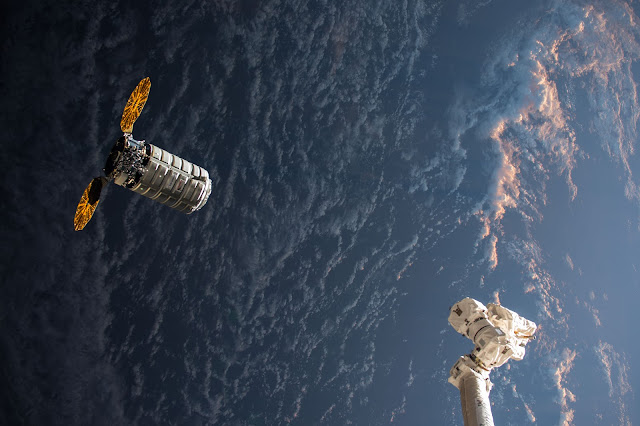
Orbital ATK's Cygnus resupply ship with its cymbal-ike UltraFlex solar arrays approaches the International Space Station's robotic arm Canadarm2 as both spacecraft fly into an orbital sunrise on November 14, 2017. The cargo craft carried almost 7,400 pounds of crew supplies, science experiments, spacewalk gear, station hardware and computer parts. New research will explore the effectiveness of antibiotics on astronauts and observe how plants absorb nutrients in microgravity. Other experiments will deploy CubeSats to explore laser communications and hybrid solar panels. Image Credit: NASA Explanation from: https://www.nasa.gov/image-feature/sunrise-flight-to-the-space-station

U Antliae

Image
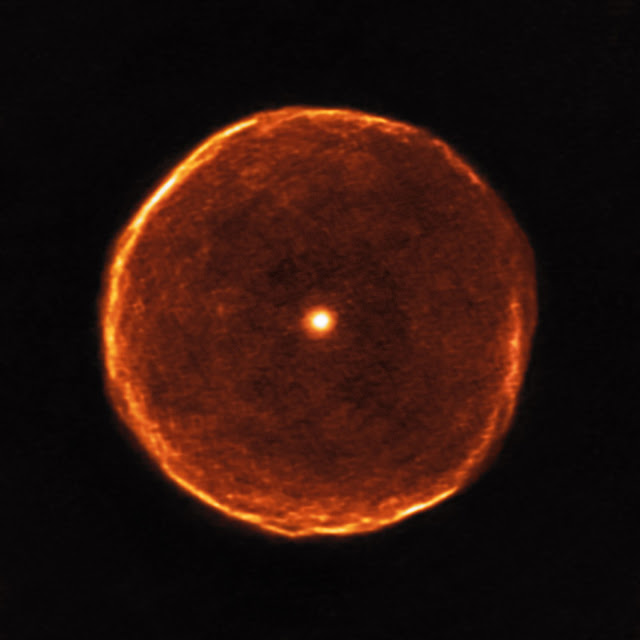
Astronomers have used ALMA to capture a strikingly beautiful view of a delicate bubble of expelled material around the exotic red star U Antliae. These observations will help astronomers to better understand how stars evolve during the later stages of their life-cycles. In the faint southern constellation of Antlia (The Air Pump) the careful observer with binoculars will spot a very red star, which varies slightly in brightness from week to week. This very unusual star is called U Antliae and new observations with the Atacama Large Millimeter/submillimeter Array (ALMA) are revealing a remarkably thin spherical shell around it. U Antliae is a carbon star, an evolved, cool and luminous star of the asymptotic giant branch type. Around 2700 years ago, U Antliae went through a short period of rapid mass loss. During this period of only a few hundred years, the material making up the shell seen in the new ALMA data was ejected at high speed. Examination of this shell in further detail also s...

Exoplanet 55 Cancri e

Image
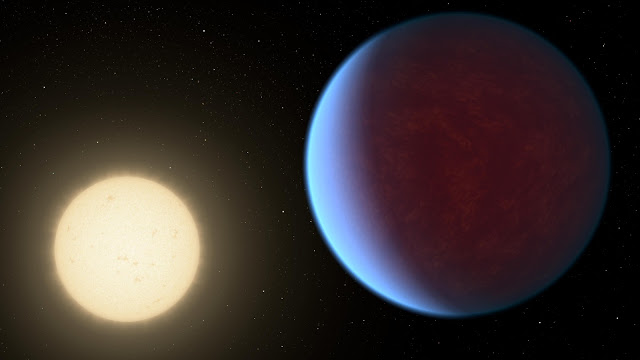
The super-Earth exoplanet 55 Cancri e, depicted with its star in this artist's concept, likely has an atmosphere thicker than Earth's but with ingredients that could be similar to those of Earth's atmosphere. Twice as big as Earth, the super-Earth 55 Cancri e was thought to have lava flows on its surface. The planet is so close to its star, the same side of the planet always faces the star, such that the planet has permanent day and night sides. Based on a 2016 study using data from NASA's Spitzer Space Telescope, scientists speculated that lava would flow freely in lakes on the starlit side and become hardened on the face of perpetual darkness. The lava on the dayside would reflect radiation from the star, contributing to the overall observed temperature of the planet. Now, a deeper analysis of the same Spitzer data finds this planet likely has an atmosphere whose ingredients could be similar to those of Earth's atmosphere, but thicker. Lava lakes directly exposed ...

Amazon River seen from the International Space Station

Image
Image Credit: ESA/NASA