Posts

Final Fantasy Full HD Desktop Wallpapers

Image
Final Fantasy Wallpapers Final fantasy has been around for many years and has captured the hearts of millions of people around the world. The HD Wallpapers created from the final fantasy series are amazing and is a delight to have on your desktop background. We compiled some images from free sources that is absolutely amazing final fantasy wallpapers , so let us know what you think!

Pillar at Sunset

Image
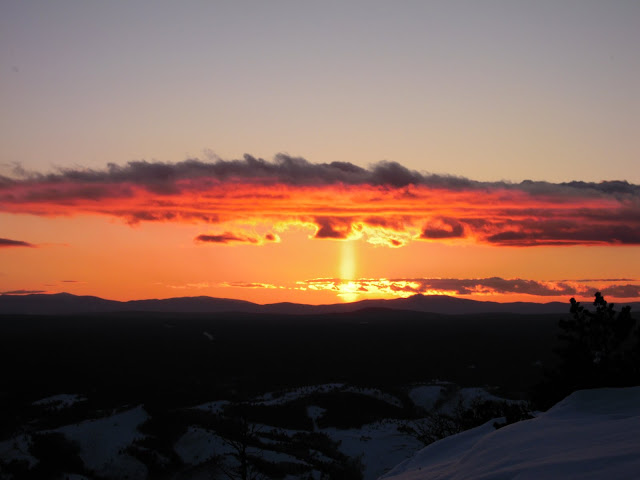
Reddened light from the setting Sun illuminates the cloud banks hugging this snowy, rugged terrain. Inspiring a moment of quiet contemplation, the sunset scene included a remarkable pillar of light that seemed to connect the clouds in the sky with the mountains below. Known as a Sun pillar, the luminous column was produced by sunlight reflecting from flat, six-sided ice crystals formed high in the cold atmosphere and fluttering toward the ground. In March 2010, astronomers watched this Sun pillar slowly fade, as the twilight deepened and clearing, dark skies came to Mt. Jelm and the Wyoming Infrared Observatory. Image Credit & Copyright: David Alquist Explanation from: http://apod.nasa.gov/apod/ap100306.html

Space Shuttle Discovery's Last Flight

Image
Climbing into cloudy skies, the Space Shuttle Orbiter Discovery (OV-103) took off from Kennedy Space Center Tuesday at 7 am local time on 17 April 2012. This time, its final departure from KSC, it rode atop a modified Boeing 747 Shuttle Carrier Aircraft. Following a farewell flyover of the Space Coast, Goddard Space Flight Center, and Washington DC, Discovery headed for Dulles International Airport in Virginia, destined to reside at the Smithsonian's National Air and Space Museum Udvar-Hazy Center. Discovery retires as NASA's most traveled shuttle orbiter, covering more than 148 million miles in 39 missions that included the delivery of the Hubble Space Telescope to orbit. Operational from 1984 through 2011, Discovery spent a total of one year in space. Image Credit & Copyright: Ben Cooper Explanation from: http://apod.nasa.gov/apod/ap120419.html

First Shuttle Launch

Image
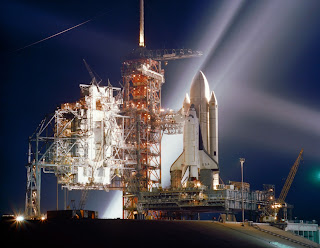
        A new era in space flight began on April 12, 1981, when Space Shuttle Columbia, or STS-1, soared into orbit from NASA's Kennedy Space Center in Florida.  Astronaut John Young, a veteran of four previous spaceflights including a walk on the moon in 1972, commanded the mission. Navy test pilot Bob Crippen piloted the mission and would go on to command three future shuttle missions. The shuttle was humankind's first re-usable spacecraft. The orbiter would launch like a rocket and land like a plane. The two solid rocket boosters that helped push them into space would also be re-used, after being recovered in the ocean. Only the massive external fuel tank would burn up as it fell back to Earth. It was all known as the Space Transportation System. Twenty years prior to the historic launch, on April 12, 1961, the era of human spaceflight began when Russian Cosmonaut Yuri Gagarin became the first human to orbit the Earth in his Vostock I spacecraft. The flight l...

Spring Fling: Sun Emits a Mid-Level Flare

Image
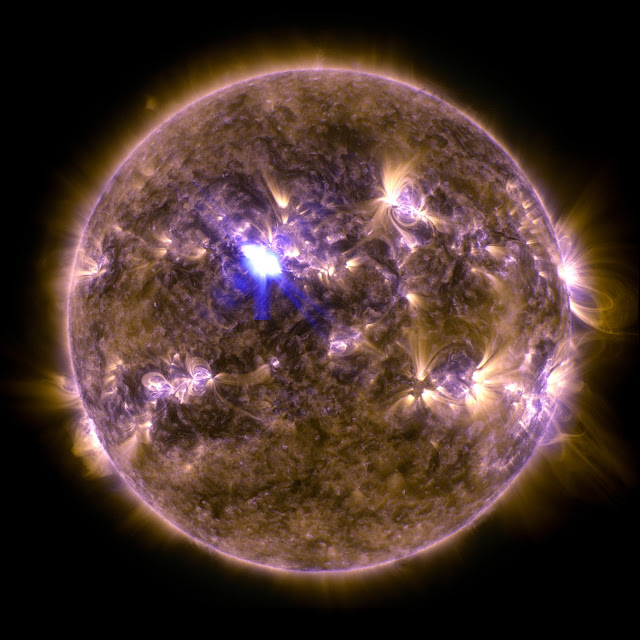
The M6.5 flare on the morning of April 11, 2013, was also associated with an Earth-directed coronal mass ejection (CME), another solar phenomenon that can send billions of tons of solar particles into space and can reach Earth one to three days later. CMEs can affect electronic systems in satellites and on the ground. Experimental NASA research models show that the CME began at 3:36 a.m. EDT on April 11, leaving the sun at over 600 miles per second. Earth-directed CMEs can cause a space weather phenomenon called a geomagnetic storm, which occurs when they connect with the outside of the Earth's magnetic envelope, the magnetosphere, for an extended period of time. The recent space weather also resulted in a weak solar energetic particle (SEP) event near Earth. These events occur when very fast protons and charged particles from the sun travel toward Earth, sometimes in the wake of a solar flare. These events are also referred to as solar radiation storms. Any harmful radiation from ...

Starburst Galaxy M82

Image
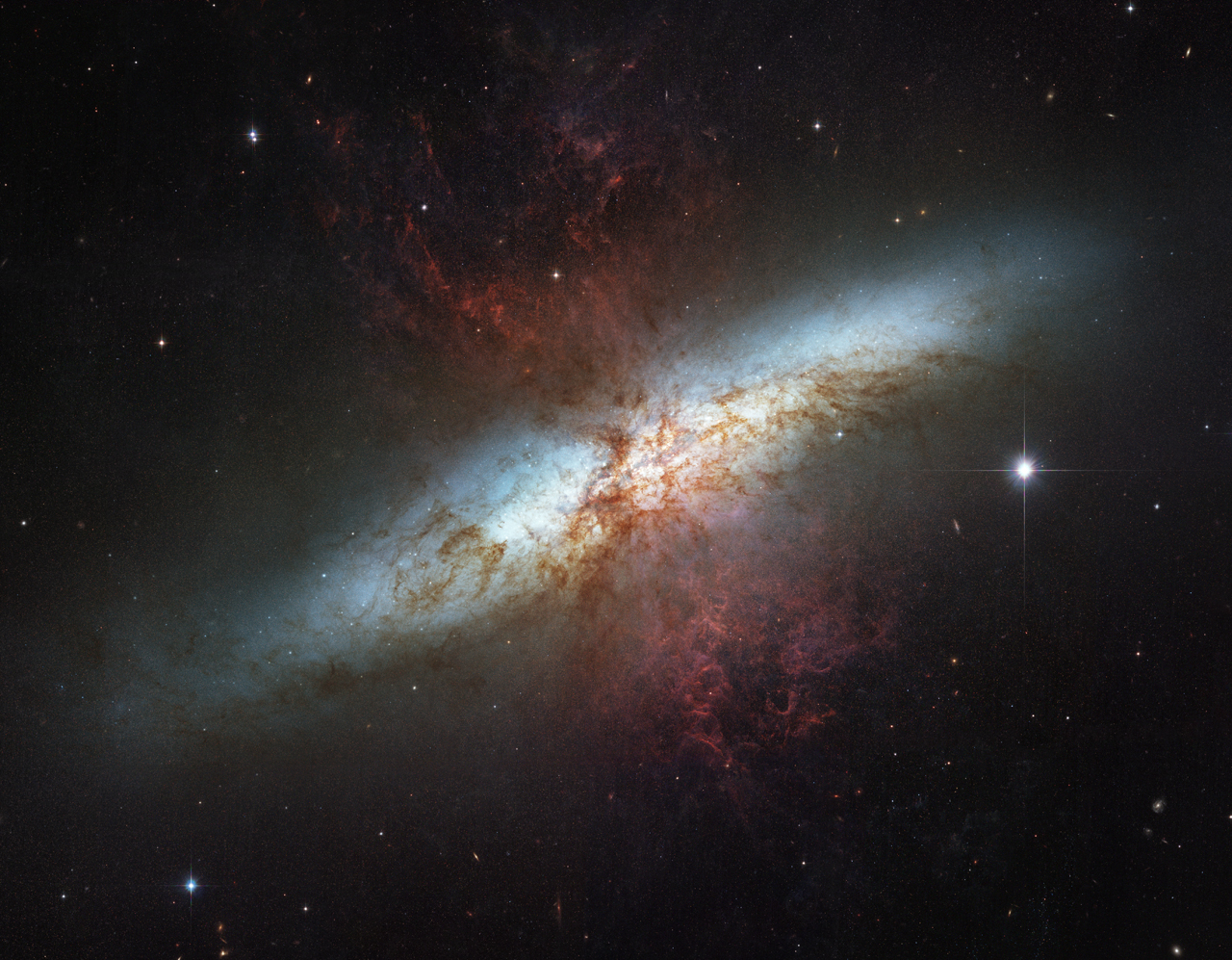
This mosaic image is the sharpest wide-angle view ever obtained of M82. The galaxy is remarkable for its bright blue disk, webs of shredded clouds, and fiery-looking plumes of glowing hydrogen blasting out of its central regions. Throughout the galaxy's center, young stars are being born 10 times faster than they are inside our entire Milky Way Galaxy. The resulting huge concentration of young stars carved into the gas and dust at the galaxy's center. The fierce galactic superwind generated from these stars compresses enough gas to make millions of more stars. In M82, young stars are crammed into tiny but massive star clusters. These, in turn, congregate by the dozens to make the bright patches, or "starburst clumps," in the central parts of M82. The clusters in the clumps can only be distinguished in the sharp Hubble images. Most of the pale, white objects sprinkled around the body of M82 that look like fuzzy stars are actually individual star clusters about 20 light...

A Sun Pillar over Sweden

Image
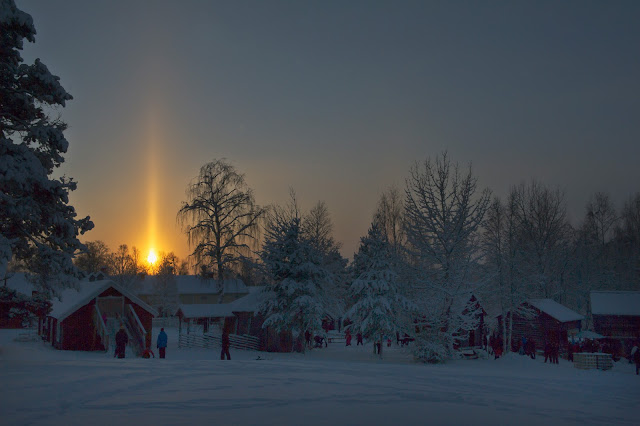
Have you ever seen a sun pillar? When the air is cold and the Sun is rising or setting, falling ice crystals can reflect sunlight and create an unusual column of light. Ice sometimes forms flat, six-sided shaped crystals as it falls from high-level clouds. Air resistance causes these crystals to lie nearly flat much of the time as they flutter to the ground. Sunlight reflects off crystals that are properly aligned, creating the sun-pillar effect. In this picture taken in December 2012, a sun-pillar reflects light from a Sun setting over Östersund, Sweden. Image Credit & Copyright: Göran Strand Explanation from: http://apod.nasa.gov/apod/ap121218.html

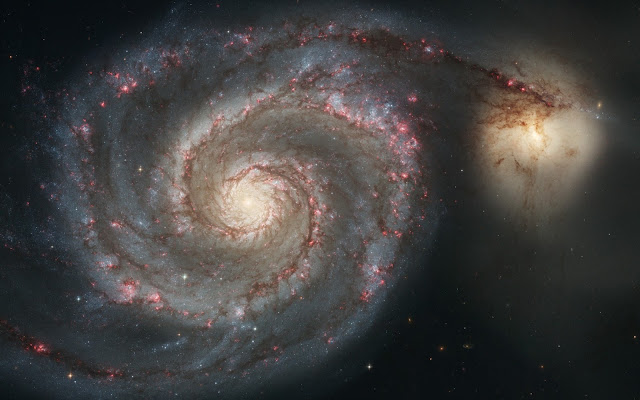
Out of This Whirl: the Whirlpool Galaxy (M51) and Companion Galaxy

Image
The graceful, winding arms of the majestic spiral galaxy M51 (NGC 5194) appear like a grand spiral staircase sweeping through space. They are actually long lanes of stars and gas laced with dust. This sharpest-ever image of the Whirlpool Galaxy, taken in January 2005 with the Advanced Camera for Surveys aboard NASA's Hubble Space Telescope, illustrates a spiral galaxy's grand design, from its curving spiral arms, where young stars reside, to its yellowish central core, a home of older stars. The galaxy is nicknamed the Whirlpool because of its swirling structure. The Whirlpool's most striking feature is its two curving arms, a hallmark of so-called grand-design spiral galaxies. Many spiral galaxies possess numerous, loosely shaped arms which make their spiral structure less pronounced. These arms serve an important purpose in spiral galaxies. They are star-formation factories, compressing hydrogen gas and creating clusters of new stars. In the Whirlpool, the assembly line b...

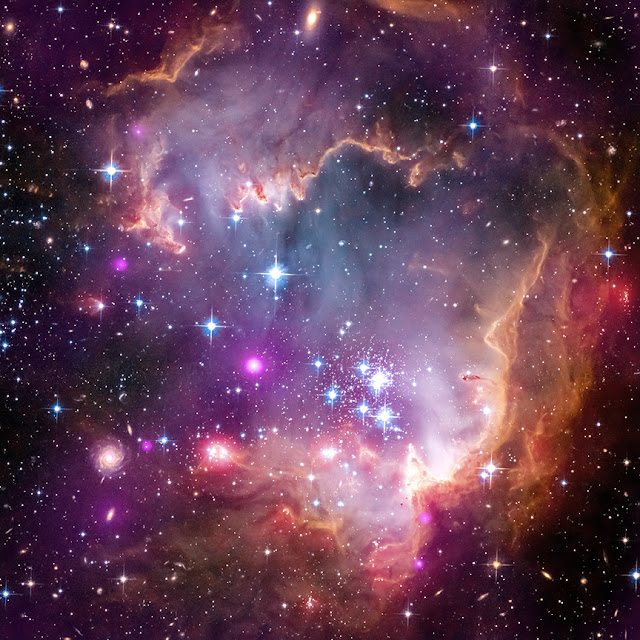
Stars in NGC 602a

Image
The Small Magellanic Cloud (SMC) is one of the Milky Way's closest galactic neighbors. Even though it is a small, or so-called dwarf galaxy, the SMC is so bright that it is visible to the unaided eye from the Southern Hemisphere and near the equator. Many navigators, including Ferdinand Magellan who lends his name to the SMC, used it to help find their way across the oceans.  Modern astronomers are also interested in studying the SMC (and its cousin, the Large Magellanic Cloud), but for very different reasons. Because the SMC is so close and bright, it offers an opportunity to study phenomena that are difficult to examine in more distant galaxies.  New Chandra data of the SMC have provided one such discovery: the first detection of X-ray emission from young stars with masses similar to our Sun outside our Milky Way galaxy. The new Chandra observations of these low-mass stars were made of the region known as the "Wing" of the SMC. In this composite image of the Wing the Ch...

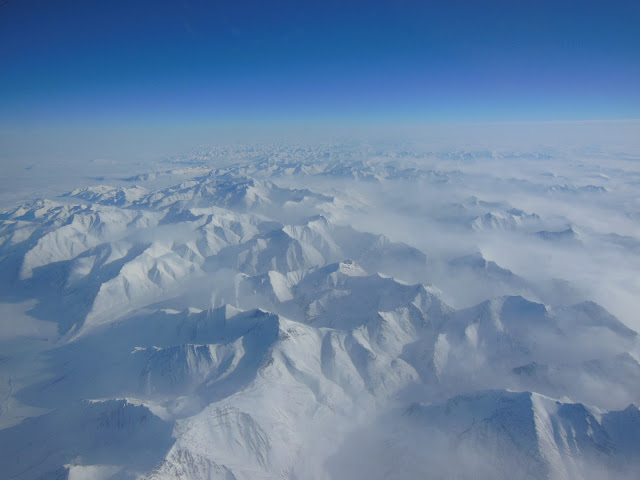
Alaskan Mountains Seen During IceBridge Transit

Image
Alaskan mountains seen from high altitude aboard the NASA P-3B during the IceBridge transit flight from Thule to Fairbanks on March 21, 2013. NASA's Operation IceBridge is an airborne science mission to study Earth's polar ice. Image Credit: NASA/Goddard/Christy Hansen

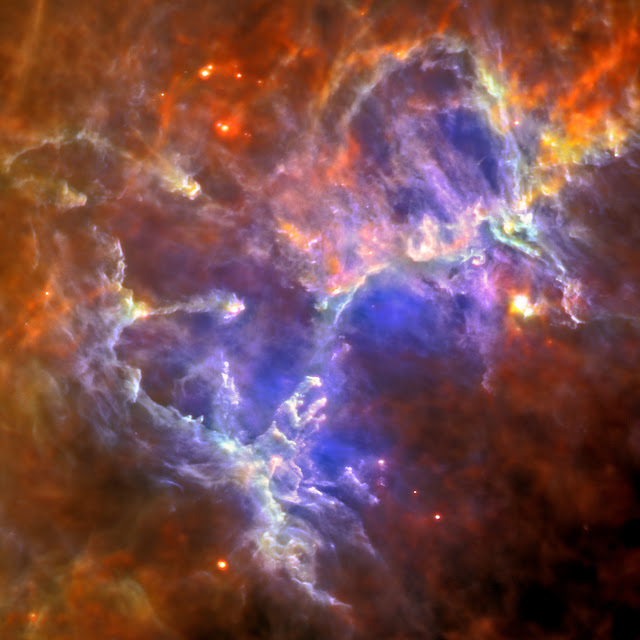
Herschel Sees Through Ghostly Pillars

Image
This Herschel image of the Eagle nebula shows the self-emission of the intensely cold nebula’s gas and dust as never seen before. Each color shows a different temperature of dust, from around 10 degrees above absolute zero (10 Kelvin or minus 442 degrees Fahrenheit) for the red, up to around 40 Kelvin, or minus 388 degrees Fahrenheit, for the blue.  Herschel reveals the nebula's intricate tendril nature, with vast cavities forming an almost cave-like surrounding to the famous pillars, which appear almost ghostly in this view. The gas and dust provide the material for the star formation that is still under way inside this enigmatic nebula.  Far-infrared light has been color-coded to 70 microns for blue and 160 microns for green using the Photodetector Array Camera, and 250 microns for red using the Spectral and Photometric Imaging Receiver.  Herschel is a European Space Agency cornerstone mission, with science instruments provided by consortia of European institutes and wi...

A Splendor Seldom Seen

Image
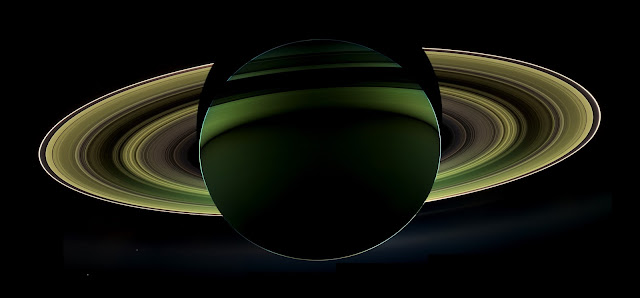
NASA's Cassini spacecraft has delivered a glorious view of Saturn, taken while the spacecraft was in Saturn's shadow. The cameras were turned toward Saturn and the sun so that the planet and rings are backlit. (The sun is behind the planet, which is shielding the cameras from direct sunlight.) In addition to the visual splendor, this special, very-high-phase viewing geometry lets scientists study ring and atmosphere phenomena not easily seen at a lower phase.  Since images like this can only be taken while the sun is behind the planet, this beautiful view is all the more precious for its rarity. The last time Cassini captured a view like this was in Sept. 2006, when it captured a mosaic processed to look like natural color, entitled "In Saturn's Shadow." In that mosaic, planet Earth put in a special appearance, making "In Saturn's Shadow" one of the most popular Cassini images to date. Earth does not appear in this mosaic as it is hidden behind the p...

The Brightness of the Sun

Image
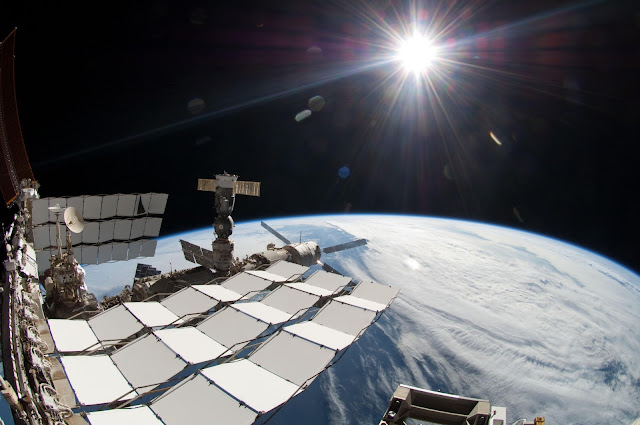
The bright Sun, a portion of the International Space Station and Earth's horizon are featured in this image photographed during the STS-134 mission's fourth spacewalk in May 2011. The image was taken using a fish-eye lens attached to an electronic still camera.  Image Credit: NASA

Churning Out Stars

Image
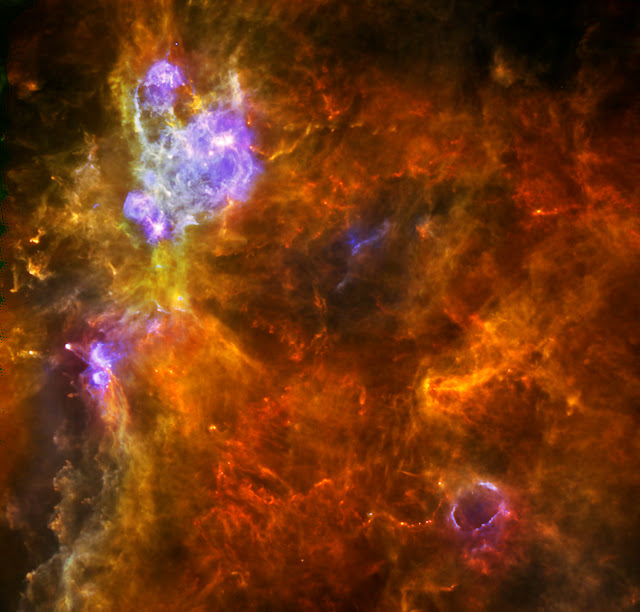
W3 is an enormous stellar nursery about 6,200 light-years away in the Perseus Arm, one of the Milky Way galaxy’s main spiral arms, which hosts both low- and high-mass star formation. In this image from the Herschel space observatory, the low-mass forming stars are seen as tiny yellow dots embedded in cool red filaments, while the highest-mass stars - with greater than eight times the mass of our Sun - emit intense radiation, heating up the gas and dust around them and appearing here in blue.  This three-color image of W3 combines Herschel bands at 70 microns (blue), 160 microns (green) and 250 microns (red). The image spans about 2 by 2 degrees. North is up and east is to the left.  Image Credit: ESA/PACS & SPIRE consortia, A. Rivera-Ingraham & P.G. Martin, Univ. Toronto, HOBYS Key Programme (F. Motte) Explanation from: http://www.nasa.gov/mission_pages/herschel/multimedia/pia16881.html

Building a Lunar Base with 3D Printing

Image
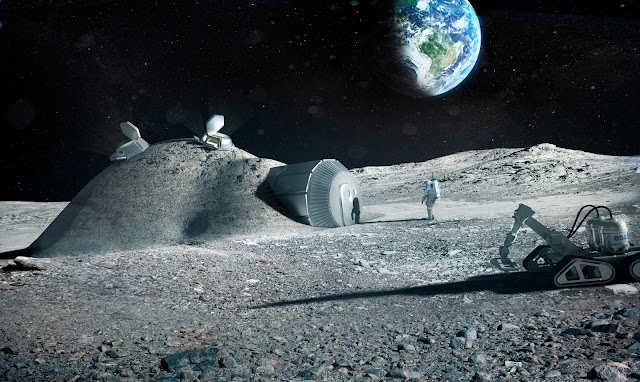
Building a base on the Moon could theoretically be made much simpler by using a 3D printer to construct it from local materials. The concept was recently endorsed by the European Space Agency (ESA) which is now collaborating with architects to gauge the feasibility of 3D printing using lunar soil. “Terrestrial 3D printing technology has produced entire structures,” explained Laurent Pambaguian, heading the project for ESA. “Our industrial team investigated if it could similarly be employed to build a lunar habitat.” According to Pambaguian, ESA’s partners have devised a weight-bearing “catenary” dome design with a cellular structured wall to help shield against micrometeoroids and space radiation – incorporating a pressurized inflatable to shelter astronauts. Meanwhile, a hollow closed-cell structure – somewhat reminiscent of bird bones – provides a combination of strength and weight. The base’s design was guided in turn by the properties of 3D-printed lunar soil, with a 1.5 ton buildi...

Mammatus Clouds over Saskatchewan

Image
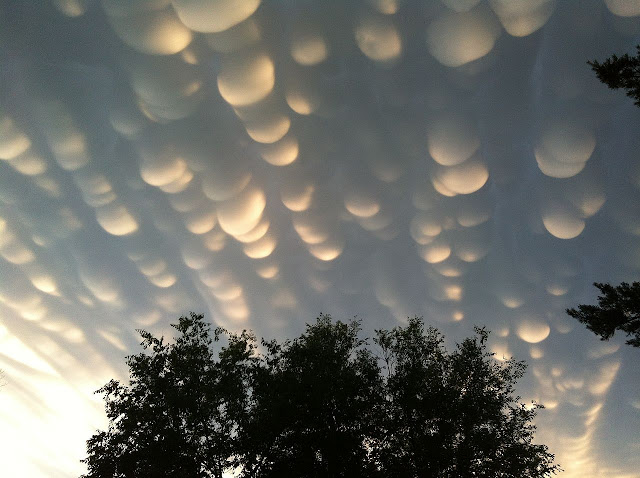
Normal cloud bottoms are flat. This is because moist warm air that rises and cools will condense into water droplets at a specific temperature, which usually corresponds to a very specific height. As water droplets grow, an opaque cloud forms. Under some conditions, however, cloud pockets can develop that contain large droplets of water or ice that fall into clear air as they evaporate. Such pockets may occur in turbulent air near a thunderstorm. Resulting mammatus clouds can appear especially dramatic if sunlit from the side. These mammatus clouds were photographed over Regina, Saskatchewan, Canada in 2011. Image Credit: Craig Lindsay Explanation from: http://apod.nasa.gov/apod/ap121023.html

Earth - The Water Planet

Image
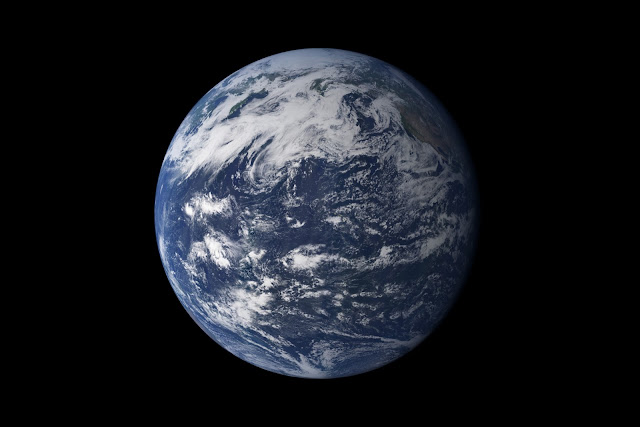
Viewed from space, the most striking feature of our planet is the water. In both liquid and frozen form, it covers 75% of the Earth’s surface. It fills the sky with clouds. Water is practically everywhere on Earth, from inside the rocky crust to inside our cells. This detailed, photo-like view of Earth is based largely on observations from the Moderate Resolution Imaging Spectroradiometer (MODIS) on NASA’s Terra satellite. It is one of many images of our watery world featured in a new story examining water in all of its forms and functions. Here is an excerpt: “In all, the Earth’s water content is about 1.39 billion cubic kilometers (331 million cubic miles), with the bulk of it, about 96.5%, being in the global oceans. As for the rest, approximately 1.7% is stored in the polar icecaps, glaciers, and permanent snow, and another 1.7% is stored in groundwater, lakes, rivers, streams, and soil. Only a thousandth of 1% of the water on Earth exists as water vapor in the atmosphere. Despite ...

Star-Forming Region S106

Image
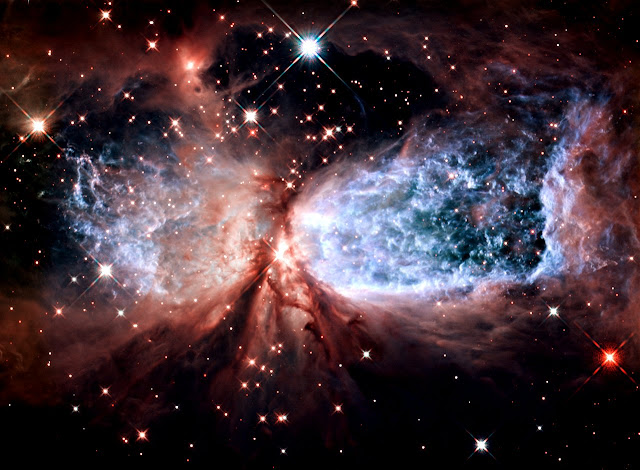
The bipolar star-forming region, called Sharpless 2-106, looks like a soaring, celestial snow angel. The outstretched "wings" of the nebula record the contrasting imprint of heat and motion against the backdrop of a colder medium. Sharpless 2-106, Sh2-106 or S106 for short, lies nearly 2,000 light-years from us. The nebula measures several light-years in length. It appears in a relatively isolated region of the Milky Way galaxy. A massive, young star, IRS 4 (Infrared Source 4), is responsible for the furious activity we see in the nebula. Twin lobes of super-hot gas, glowing blue in this image, stretch outward from the central star. This hot gas creates the "wings" of our angel. A ring of dust and gas orbiting the star acts like a belt, cinching the expanding nebula into an "hourglass" shape. Hubble's sharp resolution reveals ripples and ridges in the gas as it interacts with the cooler interstellar medium. Dusky red veins surround the blue emission fr...

The M106 Galaxy

Image
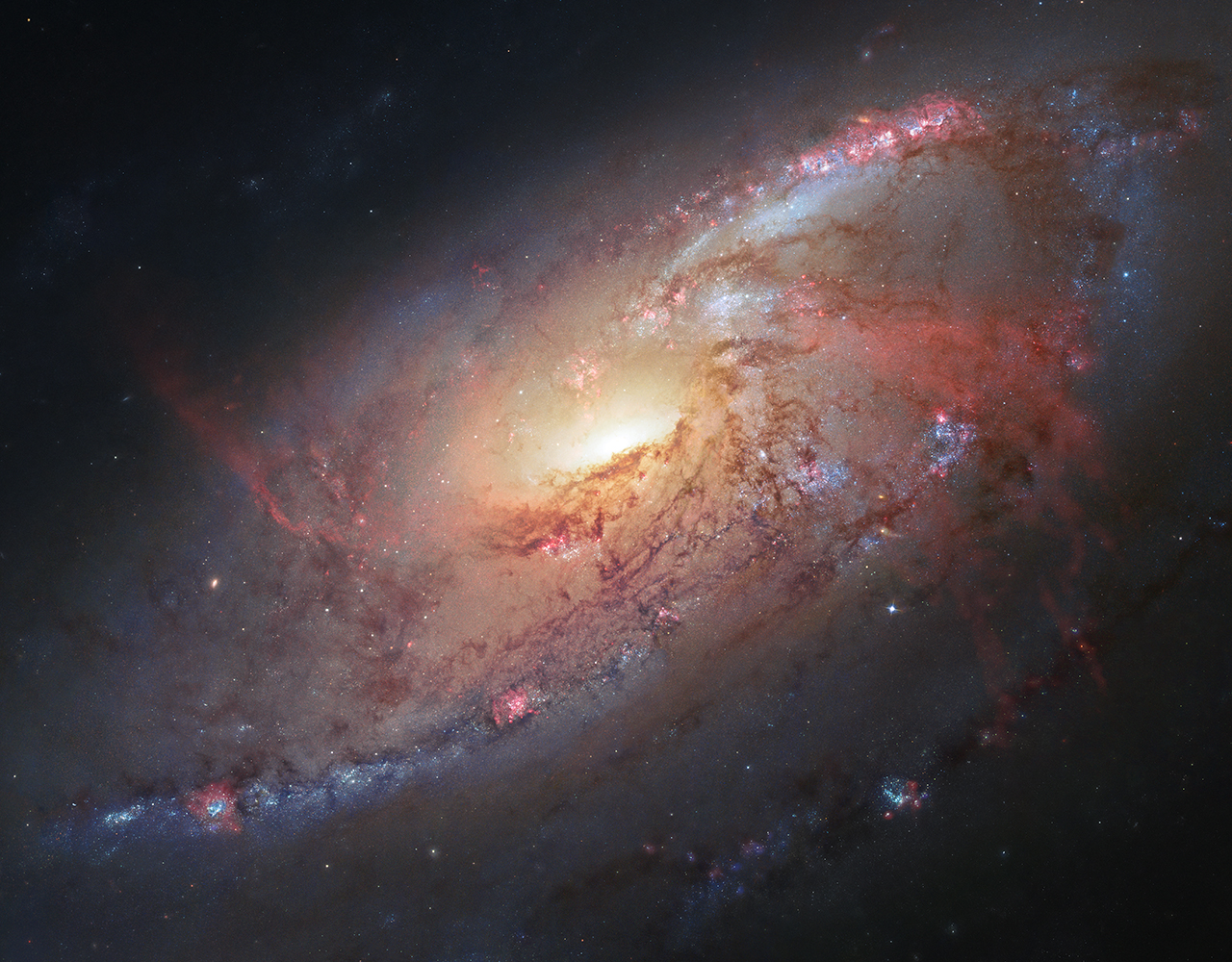
Working with astronomical image processors at the Space Telescope Science Institute in Baltimore, Md., renowned astrophotographer Robert Gendler has taken science data from the Hubble Space Telescope (HST) archive and combined it with his own ground-based observations to assemble a photo illustration of the magnificent spiral galaxy M106. Gendler retrieved archival Hubble images of M106 to assemble a mosaic of the center of the galaxy. He then used his own and fellow astrophotographer Jay GaBany's observations of M106 to combine with the Hubble data in areas where there was less coverage, and finally, to fill in the holes and gaps where no Hubble data existed. The center of the galaxy is composed almost entirely of HST data taken by the Advanced Camera for Surveys, Wide Field Camera 3, and Wide Field Planetary Camera 2 detectors. The outer spiral arms are predominantly HST data colorized with ground-based data taken by Gendler's and GaBany's 12.5-inch and 20-inch telescopes...

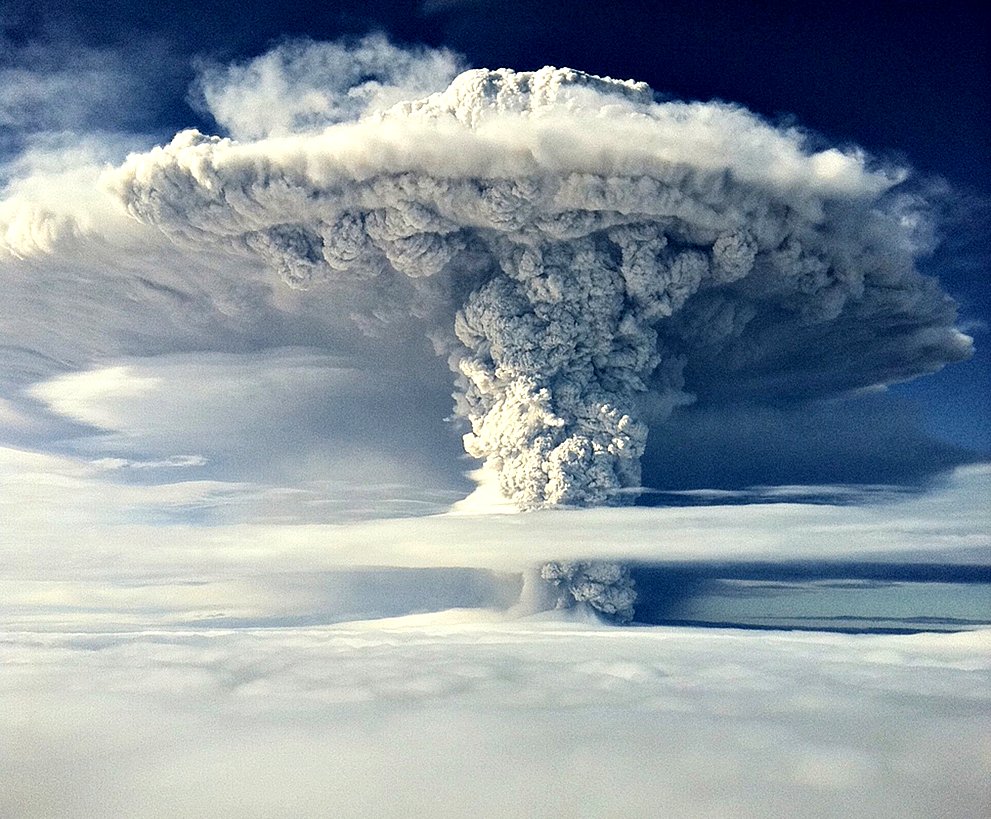
A cloud of ash above Puyehue-Cordón Caulle Volcano

Image
Osorno, Los Lagos, Chile June 5, 2011 Image Credit & Copyright: Claudio Santana