Posts

Solar Eclipse seen from Tokyo

Image
Tokyo, Kantō, Japan May 20, 2012 Image Credit: Itsuo Inouye/AP Photo

Phoenicis Lacus region of Mars

Image
Mars digital-image mosaic merged with color of the MC-17 quadrangle, Phoenicis Lacus region of Mars. Two of the four largest shield volcanoes on Mars are within the northwestern part, the south half of Pavonis Mons and Arsia Mons. The eastern part includes Syria and Sinai Plana. Most of the quadrangle forms the Tharsis plateau--the highest plateau on Mars; its elevation, 10 km, is twice that of the Tibetan Plateau, the highest plateau on Earth. Also in the northeastern part is Noctis Labyrinthus, a complex system of fault valleys at the west end of Valles Marineris. The south-central part is marked by the large fault system, Claritas Fossae. Latitude range -30 to 0 degrees, longitude range 90 to 135 degrees. Image Credit: NASA/JPL/USGS Explanation from: http://photojournal.jpl.nasa.gov/catalog/pia00177

Kepler-10b: A Scorched World

Image
Kepler-10b is a scorched world, orbiting at a distance that's more than 20 times closer to its star than Mercury is to our own Sun. The daytime temperature's expected to be more than 2,500 degrees Fahrenheit, hotter than lava flows here on Earth. Intense radiation from the star has kept the planet from holding onto an atmosphere. Flecks of silicates and iron may be boiled off a molten surface and swept away by the stellar radiation, much like a comet's tail when its orbit brings it close to the Sun. Image Credit: NASA/Kepler Mission/Dana Berry Explanation from: https://www.nasa.gov/mission_pages/kepler/multimedia/images/kepler10_3.html

Lunar Eclipse seen from Arizona

Image
Ajo, Arizona. USA Image Credit & Copyright: Frank Zullo

Lenticular Galaxy NGC 4526

Image
This neat little galaxy is known as NGC 4526. Its dark lanes of dust and bright diffuse glow make the galaxy appear to hang like a halo in the emptiness of space in this new image from the NASA/ESA Hubble Space Telescope. Although this image paints a picture of serenity, the galaxy is anything but. It is one of the brightest lenticular galaxies known, a category that lies somewhere between spirals and ellipticals. It has hosted two known supernova explosions, one in 1969 and another in 1994, and is known to have a colossal supermassive black hole at its centre that has the mass of 450 million Suns. NGC 4526 is part of the Virgo cluster of galaxies. Ground-based observations of galaxies in this cluster have revealed that a quarter of these galaxies seem to have rapidly rotating discs of gas at their centres. The most spectacular of these is this galaxy, NGC 4526, whose spinning disc of gas, dust, and stars reaches out uniquely far from its heart, spanning some 7% of the galaxy's ent...

The Lagoon Nebula

Image
Like a Dali masterpiece, this image of Messier 8 from the NASA/ESA Hubble Space Telescope is both intensely colourful and distinctly surreal. Located in the constellation of Sagittarius (The Archer), this giant cloud of glowing interstellar gas is a stellar nursery that is also known as the Lagoon Nebula. Although the name definitely suits the beauty of this object, “lagoon” does suggest tranquillity and there is nothing placid about the high-energy radiation causing these intricate clouds to glow. The massive stars hiding within the heart of the nebula give off enormous amounts of ultraviolet radiation, ionising the gas and causing it to shine colourfully, as well as sculpting the surrounding nebula into strange shapes. The result is an object around four to five thousand light-years away which, on a clear night, is faintly visible to the naked eye. Since it was first recorded back in the 1747 this object has been photographed and analysed at many different wavelengths. By using infra...

Solar Eclipse over Svalbard

Image
Svalbard, Norway March 20, 2015 Image Credit & Copyright: David Jiménez

NGC 4424 & LEDA 213994 Galaxies

Image
Some astronomical objects have endearing or quirky nicknames, inspired by mythology or their own appearance. Take, for example, the constellation of Orion (The Hunter), the Sombrero Galaxy, the Horsehead Nebula, or even the Milky Way. However, the vast majority of cosmic objects appear in astronomical catalogues, and are given rather less poetic names based on the order of their discovery. Two galaxies are clearly visible in this Hubble image, the larger of which is NGC 4424. This galaxy is catalogued in the New General Catalogue of Nebulae and lusters of Stars (NGC), which was compiled in 1888. The NGC is one of the largest astronomical catalogues, which is why so many Hubble Pictures of the Week feature NGC objects. In total there are 7840 entries in the catalogue and they are also generally the larger, brighter, and more eye-catching objects in the night sky, and hence the ones more easily spotted by early stargazers. The smaller, flatter, bright galaxy sitting just below NGC 4424 i...

Extreme Planets

Image
This artist's concept depicts the pulsar planet system discovered in 1992 using the Arecibo radio telescope in Puerto Rico. Three pulsar planets - the first of any kind ever found outside our Solar System - circling a pulsar called PSR B1257+12. Pulsars are rapidly rotating neutron stars, which are the collapsed cores of exploded massive stars. They spin and pulse with radiation, much like a lighthouse beacon. Here, the pulsar's twisted magnetic fields are highlighted by the blue glow. All three pulsar planets are shown in this picture; the farthest two from the pulsar (closest in this view) are about the size of Earth. Radiation from charged pulsar particles would probably rain down on the planets, causing their night skies to light up with auroras similar to our Northern Lights. One such aurora is illustrated on the planet at the bottom of the picture. Since this landmark discovery, more than 160 extrasolar planets have been observed around stars that are burning nuclear fuel...

The south pole of Jupiter

Image
This enhanced-color image of Jupiter's south pole and its swirling atmosphere was created by citizen scientist Roman Tkachenko using data from the JunoCam imager on NASA's Juno spacecraft. Juno acquired the image, looking directly at the Jovian south pole, on February 2, 2017, at 6:06 a.m. PST (9:06 a.m. EST) from an altitude of about 63,400 miles (102,100 kilometers) above Jupiter's cloud tops. Cyclones swirl around the south pole, and white oval storms can be seen near the limb -- the apparent edge of the planet. Image Credit: NASA/JPL-Caltech/SwRI/MSSS/Roman Tkachenko Explanation from: http://photojournal.jpl.nasa.gov/catalog/PIA21381

Villarrica Volcano Eruption

Image
Villarrica, Chile March 3, 2015 Image Credit: Ariel Marinkovic

Earth seen from the International Space Station

Image
ISS, Orbit of the Earth September 2016 Image Credit: NASA/ESA

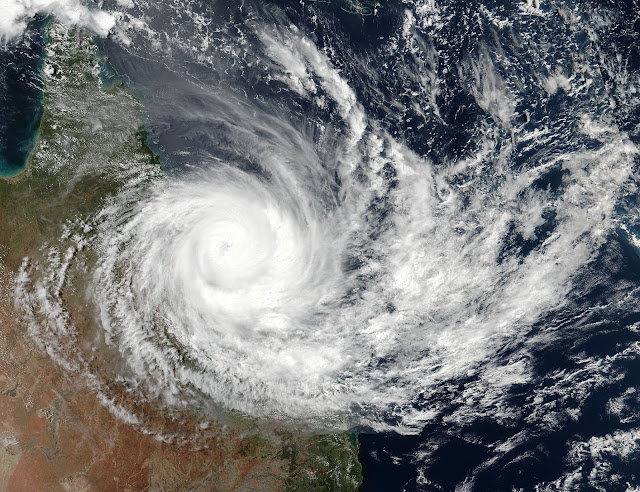
Cyclone Debbie

Image
On March 28 at 03:42 UTC (1:42 p.m. AEST Queensland local time /Mar. 27 at 11:42 p.m. EST) NASA-NOAA's Suomi NPP satellite captured this visible image of Tropical Cyclone Debbie over eastern Australia. Before Debbie made landfall, NASA's Aqua satellite analyzed the temperatures in the storm on Mar. 27 at 0347 UTC (Mar. 26 at 11:47 pm. EST). The infrared imagery showed a large area of cloud top temperatures in thunderstorms around Debbie's eye as cold as near minus 63.1 degrees Celsius or minus 81.6 degrees Fahrenheit. Cloud top temperatures that cold have been shown to produce heavy rainfall. Cyclone Debbie made landfall north of Proserpine at Airlie Beach on March 28, shortly after noon AEST/Queensland local time (0200 UTC/March 27 at 10 p.m. EST). The Australian Bureau of Meteorology noted wind gusts stronger than 160 mph (260 kph) were recorded near landfall. The strong winds downed trees and powerlines. Power losses occurred in a large area between the towns of Bowen an...

Stars Born in Winds from Supermassive Black Holes

Image
Artist’s impression of a galaxy forming stars within powerful outflows of material blasted out from supermassive black holes at its core. Results from ESO’s Very Large Telescope are the first confirmed observations of stars forming in this kind of extreme environment. The discovery has many consequences for understanding galaxy properties and evolution. Observations using ESO’s Very Large Telescope have revealed stars forming within powerful outflows of material blasted out from supermassive black holes at the cores of galaxies. These are the first confirmed observations of stars forming in this kind of extreme environment. The discovery has many consequences for understanding galaxy properties and evolution. The results are published in the journal Nature. A UK-led group of European astronomers used the MUSE and X-shooter instruments on the Very Large Telescope (VLT) at ESO’s Paranal Observatory in Chile to study an ongoing collision between two galaxies, known collectively as IRAS F2...

Milky Way Galaxy seen over VLT’s four 8.2-metre Unit Telescopes

Image
ESO's Very Large Telescope (VLT) looks more like a very small telescope in this image! From this perspective, it is difficult to make out the silhouettes of the VLT’s four 8.2-metre Unit Telescopes, which sit atop Cerro Paranal in the Chilean Atacama Desert. The VLT’s location was very carefully selected. It is vital for the site to be as dry as possible, as water vapour can absorb infrared light and degrade observations. In order to reduce the effects of Earth’s atmosphere as far as possible, the VLT is at 2600 metres above sea level, minimising the amount of atmosphere sitting between it and the stars. Due to its remote location, Paranal manages to be mostly undisturbed and light-free. Even the winding roads that lead through the Atacama Desert to the observation site are dimly lit to avoid unnecessary light pollution. In this image, a trail of stars cuts across the the night sky like smoke rising from a celestial chimney. This is our home galaxy, the Milky Way. Towards the top o...

Was 49 Galaxy Merger

Image
A supermassive black hole inside a tiny galaxy is challenging scientists' ideas about what happens when two galaxies become one. Was 49 is the name of a system consisting of a large disk galaxy, referred to as Was 49a, merging with a much smaller "dwarf" galaxy called Was 49b. The dwarf galaxy rotates within the larger galaxy's disk, about 26,000 light-years from its center. Thanks to NASA's Nuclear Spectroscopic Telescope Array (NuSTAR) mission, scientists have discovered that the dwarf galaxy is so luminous in high-energy X-rays, it must host a supermassive black hole much larger and more powerful than expected. "This is a completely unique system and runs contrary to what we understand of galaxy mergers," said Nathan Secrest, lead author of the study and postdoctoral fellow at the U.S. Naval Research Laboratory in Washington. Data from NuSTAR and the Sloan Digital Sky Survey suggest that the mass of the dwarf galaxy's black hole is huge, compared...

Aurora over Alaska

Image
Alaska, USA Image Credit: Michio Hoshino

CoRoT-2a: Star Blasts Planet With X-rays

Image
This artist's representation shows the CoRoT-2 system, which is found about 880 light years from Earth. The system, which is estimated to be between 100 and 300 million years old, contains a star and a planet in close orbit around it. The separation between the star and the planet is only three percent of the distance between the Earth and the Sun, causing some exotic effects not seen in our solar system. The illustration shows the material, in blue, being stripped off the planet as X-rays from the star pummel the planet. A star is blasting a planet in its orbit with an extremely high level of X-rays. This high-energy radiation is eroding the planet at a rate of 5 million tons of material per second. The planet, in turn, may be speeding up the star's rotation, which keeps the star's magnetic fields very active. This graphic contains an image and illustration of a nearby star, named CoRoT-2a, which has a planet in close orbit around it. The separation between the star and pl...

Total Solar Eclipse over Svalbard

Image
Svalbard, Norway March 20, 2015 Image Credit & Copyright: Miloslav DruckmÃŒller

Spiral Galaxy Messier 96

Image
Not all spiral galaxies have to be picture-perfect to be striking. Messier 96, also known as NGC 3368, is a case in point: its core is displaced from the centre, its gas and dust are distributed asymmetrically and its spiral arms are ill-defined. But this portrait, taken with the FORS1 instrument on ESO’s Very Large Telescope, shows that imperfection is beauty in Messier 96. The galaxy's core is compact but glowing, and the dark dust lanes around it move in a delicate swirl towards the nucleus. And the spiral arms, patchy rings of young blue stars, are like necklaces of blue pearls. Messier 96 lies in the constellation of Leo (The Lion). It is the largest galaxy in the Leo I group of galaxies; including its outermost spiral arms, it spans some 100 000 light-years in diameter — about the size of our Milky Way. Its graceful imperfections likely result from the gravitational pull of other members in the group, or are perhaps due to past galactic encounters. A multitude of background g...