Posts

Planetary Nebula NGC 7009

Image
The spectacular planetary nebula NGC 7009, or the Saturn Nebula, emerges from the darkness like a series of oddly-shaped bubbles, lit up in glorious pinks and blues. This colourful image was captured by the powerful MUSE instrument on ESO’s Very Large Telescope (VLT), as part of a study which mapped the dust inside a planetary nebula for the first time. The map — which reveals a wealth of intricate structures in the dust, including shells, a halo and a curious wave-like feature — will help astronomers understand how planetary nebulae develop their strange shapes and symmetries. The Saturn Nebula is located approximately 5000 light years away in the constellation of Aquarius (The Water Bearer). Its name derives from its odd shape, which resembles everyone’s favourite ringed planet seen edge-on. But in fact, planetary nebulae have nothing to do with planets. The Saturn Nebula was originally a low-mass star, which expanded into a red giant at the end of its life and began to shed its oute...

Exoplanet WASP-12b

Image
Astronomers have discovered that the well-studied exoplanet WASP-12b reflects almost no light, making it appear essentially pitch black. This discovery sheds new light on the atmospheric composition of the planet and also refutes previous hypotheses about WASP-12b’s atmosphere. The results are also in stark contrast to observations of another similarly sized exoplanet. Using the Space Telescope Imaging Spectrograph (STIS) on the NASA/ESA Hubble Space Telescope, an international team led by astronomers at McGill University, Canada, and the University of Exeter, UK, have measured how much light the exoplanet WASP-12b reflects — its albedo — in order to learn more about the composition of its atmosphere. The results were surprising, explains lead author Taylor Bell, a Master’s student in astronomy at McGill University who is affiliated with the Institute for Research on Exoplanets: “The measured albedo of WASP-12b is 0.064 at most. This is an extremely low value, making the planet darker ...

Spiral Galaxy NGC 6384

Image
The NASA/ESA Hubble Space Telescope has produced this finely detailed image of the beautiful spiral galaxy NGC 6384. This galaxy lies in the constellation of Ophiuchus (The Serpent Bearer), not far from the centre of the Milky Way on the sky. The positioning of NGC 6384 means that we have to peer at it past many dazzling foreground Milky Way stars that are scattered across this image. In 1971, one member of NGC 6384 stood out against these bright foreground stars when one of its stars exploded as a supernova. This was a Type Ia supernova, which occurs when a compact star that has ceased fusion in its core, called a white dwarf, increases its mass beyond a critical limit by gobbling up matter from a companion star. A runaway nuclear explosion then makes the star suddenly as bright as a whole galaxy. While many stars have already come to the ends of their lives in NGC 6384, in the centre, star formation is being fuelled by the galaxy’s bar structure; astronomers think such galactic bars ...

Star-Forming Region NGC 6729

Image
This image from ESO’s Very Large Telescope gives a close-up view of the dramatic effects new-born stars have on the gas and dust from which they formed. Although the stars themselves are not visible, material they have ejected is colliding with the surrounding gas and dust clouds and creating a surreal landscape of glowing arcs, blobs and streaks. The star-forming region NGC 6729 is part of one of the closest stellar nurseries to the Earth and hence one of the best studied. This new image from ESO’s Very Large Telescope gives a close-up view of a section of this strange and fascinating region. The data were selected from the ESO archive by Sergey Stepanenko as part of the Hidden Treasures competition. Sergey’s picture of NGC 6729 was ranked third in the competition. Stars form deep within molecular clouds and the earliest stages of their development cannot be seen in visible-light telescopes because of obscuration by dust. In this image there are very young stars at the upper left of t...

Alpha Centauri and Beta Centauri

Image
At the centre of this image of the Centaurus constellation are Alpha Centauri and Beta Centauri, two triple star systems. The brightest stars of both systems orbit near to each other, making them appear as one star. Alpha Centauri is the nearest "star" to Earth except for the Sun. This photograph of the Centaurus constellation was taken at ESO's La Silla Observatory. Image Credit: ESO Explanation from: https://www.eso.org/public/images/centaurus-ch17-bardon-cc/

Exoplanet WASP-19b

Image
Astronomers using ESO’s Very Large Telescope have detected titanium oxide in an exoplanet atmosphere for the first time. This discovery around the hot-Jupiter planet WASP-19b exploited the power of the FORS2 instrument. It provides unique information about the chemical composition and the temperature and pressure structure of the atmosphere of this unusual and very hot world. A team of astronomers led by Elyar Sedaghati, an ESO fellow and recent graduate of TU Berlin, has examined the atmosphere of the exoplanet WASP-19b in greater detail than ever before. This remarkable planet has about the same mass as Jupiter, but is so close to its parent star that it completes an orbit in just 19 hours and its atmosphere is estimated to have a temperature of about 2000 degrees Celsius. As WASP-19b passes in front of its parent star, some of the starlight passes through the planet’s atmosphere and leaves subtle fingerprints in the light that eventually reaches Earth. By using the FORS2 instrument ...

Jupiter seen by NASA's Juno spacecraft

Image
This series of enhanced-color images shows Jupiter up close and personal, as NASA's Juno spacecraft performed its eighth flyby of the gas giant planet. The images were obtained by JunoCam. From left to right, the sequence of images taken on September 1, 2017 from 3:03 p.m. to 3:11 p.m. PDT (6:03 p.m. to 6:11 p.m. EDT). At the times the images were taken, the spacecraft ranged from 7,545 to 14,234 miles (12,143 to 22,908 kilometers) from the tops of the clouds of the planet at a latitude range of -28.5406 to -44.4912 degrees. Image Credit: NASA/JPL-Caltech/SwRI/MSSS/Gerald Eichstadt/Sean Doran Explanation from: https://photojournal.jpl.nasa.gov/catalog/PIA21780

Earth and three hurricanes seen by Suomi NPP satellite

Image
There was no shortage of storms brewing across the Atlantic basin in September 2017. On September 6, hurricanes Katia, Irma, and Jose lined up across the basin. The trio is visible in this image, captured that day by the Visible Infrared Imaging Radiometer Suite (VIIRS) on the Suomi NPP satellite. The image is a mosaic, assembled from images acquired throughout the day during several orbits of the satellite. On September 6, Katia had strengthened over the southwestern Gulf of Mexico and was upgraded from tropical storm to hurricane status. The eye of Irma, a raging category 5 storm, passed north of Puerto Rico but still delivered strong winds and rain the Caribbean island. Meanwhile, Jose spun in the central Atlantic Ocean, and was also upgraded that day from a tropical storm to hurricane. The bright strips are reflected sunlight, or “glint,” which show up over ocean areas in the middle of each orbit. Image Credit: NASA Earth Observatory Explanation from: https://earthobservatory.nasa....

In search of exoplanets

Image
The Search for habitable Planets EClipsing ULtra-cOOl Stars (SPECULOOS) telescope will search for terrestrial exoplanets around nearby ultracool stars and brown dwarfs when it has first light in December 2017. SPECULOOS joins a fleet of exoplanet-searching telescopes, including the two TRAnsiting Planets and PlanetesImals Small Telescopes(TRAPPIST)— one at ESO’s La Silla Observatory in Chile and another at Oukaïmden Observatory in Morocco. Image Credit: H. Zodet/ESO Explanation from: https://www.eso.org/public/images/upr-kh9a0928-cc/

X8.2 Solar Flare

Image
The Sun emitted a significant solar flare, peaking at 12:06 p.m. EDT on September 10, 2017. NASA’s Solar Dynamics Observatory, which watches the Sun constantly, captured an image of the event. Solar flares are powerful bursts of radiation. Harmful radiation from a flare cannot pass through Earth's atmosphere to physically affect humans on the ground, however — when intense enough — they can disturb the atmosphere in the layer where GPS and communications signals travel. This flare is classified as an X8.2-class flare. X-class denotes the most intense flares, while the number provides more information about its strength. An X2 is twice as intense as an X1, an X3 is three times as intense, etc. This flare is the capstone on a series of flares from Active Region 2673, which was identified on August 29 and is currently rotating off the front of the Sun as part of our star’s normal rotation. Image Credit: NASA/SDO/Goddard Explanation from: https://www.nasa.gov/feature/goddard/2017/activ...

Smoke over the United States seen by Suomi NPP satellite

Image
With dozens of wildfires burning across the western United States and Canada, many North Americans have had the acrid taste of smoke in their mouths during the past few weeks. On September 5, 2017, the National Interagency Fire Center (NIFC) reported more than 80 large fires burning in nine western U.S. states. People living in large stretches of northern California, Oregon, Washington, Montana, and Idaho have been breathing what the U.S. government’s Air Now website rated as “hazardous” air. The natural-color mosaic above was made from several scenes acquired on September 4, 2017, by the Visible Infrared Imaging Radiometer Suite (VIIRS) on the Suomi National Polar-orbiting Partnership (Suomi-NPP) satellite. The Ozone Mapper Profiler Suite (OMPS) on Suomi NPP also collected data on airborne aerosols as they were swept by winds from west to east across the continental United States (second image). The OMPS map depicts relative aerosol concentrations, with lower concentrations appearing ...

Saturn seen by Cassini spacecraft

Image
With this view, Cassini captured one of its last looks at Saturn and its main rings from a distance. The Saturn system has been Cassini's home for 13 years, but that journey is nearing its end. Cassini has been orbiting Saturn for nearly a half of a Saturnian year but that journey is nearing its end. This extended stay has permitted observations of the long-term variability of the planet, moons, rings, and magnetosphere, observations not possible from short, fly-by style missions. When the spacecraft arrived at Saturn in 2004, the planet's northern hemisphere, seen here at top, was in darkness, just beginning to emerge from winter. Now at journey's end, the entire north pole is bathed in the continuous sunlight of summer. Images taken on October 28, 2016 with the wide angle camera using red, green and blue spectral filters were combined to create this color view. This view looks toward the sunlit side of the rings from about 25 degrees above the ringplane. The view was acqu...

Spiral Galaxy NGC 5398

Image
This NASA/ESA Hubble Space Telescope picture shows NGC 5398, a barred spiral galaxy located about 55 million light-years away. The galaxy is famous for containing an especially extensive HII region, a large cloud composed of ionised hydrogen (or HII, pronounced “H-two”, with H being the chemical symbol for hydrogen and the “II” indicating that the atoms have lost an electron to become ionised). NGC 5398’s cloud is named Tol 89 and sits at the lower left end of the galaxy’s central “bar” of stars, a structure that cuts through the galactic core and funnels material inwards to maintain the star formation occurring there. Tol 86 is conspicuous in being the only large massive star forming complex in the entire galaxy, with an extension of roughly 5000 times 4000 light-years; it contains at least seven young and massive star clusters. The two brightest clumps within Tol 89, which astronomers have named simply “A” and “B”, appear to have undergone two bursts of star-forming activity — “starb...

Three hurricanes seen by Suomi NPP satellite

Image
Meteorologists struggled to find the right words to describe the situation as a line of three hurricanes—two of them major and all of them threatening land—brewed in the Atlantic basin in September 2017. Forecasters were most concerned about Irma, which was on track to make landfall in densely populated South Florida on September 10 as a large category 4 storm. Meanwhile, category 2 Hurricane Katia was headed for Mexico, where it was expected to make landfall on September 9. And just days after Irma devastated the Leeward Islands, the chain of small Caribbean islands braced for another blow—this time from category 4 Hurricane Jose. The Visible Infrared Imaging Radiometer Suite (VIIRS) on the Suomi NPP satellite captured the data for a mosaic of Katia, Irma, and Jose as they appeared in the early hours of September 8, 2017. The images were acquired by the VIIRS “day-night band,” which detects light signals in a range of wavelengths from green to near-infrared, and uses filtering techniq...

Interacting Galaxies NGC 2207 • IC 2163

Image
NGC 2207 and IC 2163 are two spiral galaxies in the process of merging. This pair contains a large collection of super bright X-ray objects called "ultraluminous X-ray sources" (ULXs). Astronomers have found evidence for three supernova explosions within this pair in the past 15 years. A new composite image of the system contains X-rays from Chandra (pink) along with optical and infrared data. At this time of year, there are lots of gatherings often decorated with festive lights. When galaxies get together, there is the chance of a spectacular light show as is the case with NGC 2207 and IC 2163 Located about 130 million light years from Earth, in the constellation of Canis Major, this pair of spiral galaxies has been caught in a grazing encounter. NGC 2207 and IC 2163 have hosted three supernova explosions in the past 15 years and have produced one of the most bountiful collections of super bright X-ray lights known. These special objects — known as "ultraluminous X-ray ...

Star-Forming Region Messier 43

Image
The NASA/ESA Hubble Space Telescope has taken a close-up view of an outer part of the Orion Nebula’s little brother, Messier 43. This nebula, which is sometimes referred to as De Mairan’s Nebula after its discoverer, is separated from the famous Orion Nebula (Messier 42) by only a dark lane of dust. Both nebulae are part of the massive stellar nursery called the Orion molecular cloud complex, which includes several other nebulae, such as the Horsehead Nebula (Barnard 33) and the Flame Nebula (NGC 2024). The Orion molecular cloud complex is about 1400 light-years away, making it one of the closest massive star formation regions to Earth. Hubble has therefore studied this extraordinary region extensively over the past two decades, monitoring how stellar winds sculpt the clouds of gas, studying young stars and their surroundings and discovering many elusive objects, such as brown dwarf stars. This view shows several of the brilliant hot young stars in this less-studied region and it also ...

Hurricane Irma seen by NASA’s Terra satellite

Image
The Moderate Resolution Imaging Spectroradiometer (MODIS) on NASA’s Terra satellite acquired a natural-color image of Irma at 10:00 a.m. local time (16:00 Universal Time) on September 8, 2017. Image Credit: NASA

Dwarf Galaxy IC 2574

Image
The NASA/ESA Hubble Space Telescope has imaged a region of space containing the intriguing object IC 2574. Pink bubbles blown by supernova explosions abound in this faint galaxy. The colour of these shells comes from hydrogen gas irradiated by newborn stars. The formation of the stars was triggered by shock waves from earlier supernova detonations that compressed material together. IC 2574 is commonly known as Coddington's Nebula after the American astronomer Edwin Coddington, who discovered it in 1898. Astronomers classify IC 2574 as a dwarf irregular galaxy due to its relatively small size and lack of organisation or structure. These galaxies are thought to resemble some of the earliest that formed in the Universe. Dwarf irregular galaxies thus serve as useful "living fossils" for studying the evolution of more complex galaxy types such as our home, the Milky Way, with its central bar and spiral arms. The expanding shells in IC 2574 are of particular interest to astrono...

The Eagle Nebula

Image
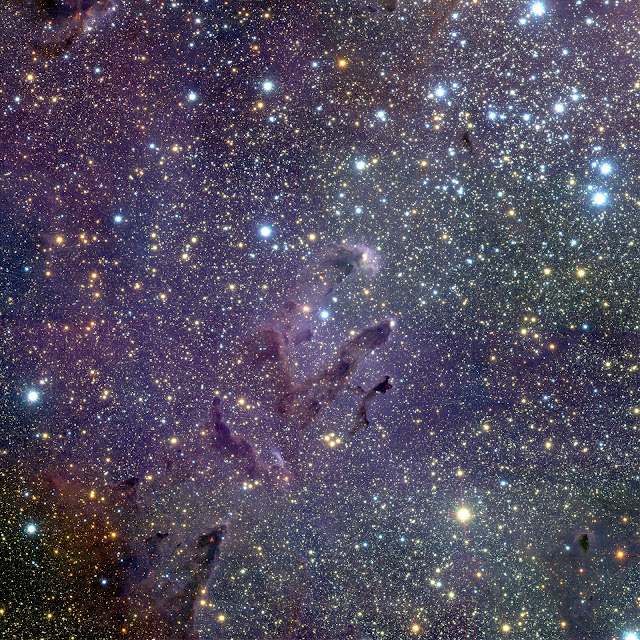
Messier 16 (M16), also known as the Eagle Nebula, is located in the southern constellation of Serpens (the Snake). Using the infrared multi-mode ISAAC instrument on the 8.2-m VLT ANTU telescope, European astronomers were able to image the Eagle Nebula at near-infrared wavelength. The ISAAC near-infrared images cover a 9 x 9 arcminutes region, in three broad-band colours and with sufficient sensitivity to detect young stars of all masses and — most importantly — with an image sharpness as good as 0.35 arcseconds. The wide-field view of M16 shows that there is much happening in the region. The first impression one gets is of an enormous number of stars. Those which are blue in the infrared image are either members of the young NGC 6611 cluster — whose massive stars are concentrated in the upper right (north west) part of the field — or foreground stars which happen to lie along the line of sight towards M16. Most of the stars are fainter and more yellow. They are ordinary stars behind M1...

Hurricane Irma seen by NOAA's GOES East satellite

Image
NOAA's GOES East satellite captured this infrared image of Hurricane Irma in the Bahamas on September 8 at 4:45 a.m. EDT. Image Credit: NASA/NOAA GOES Project