Posts

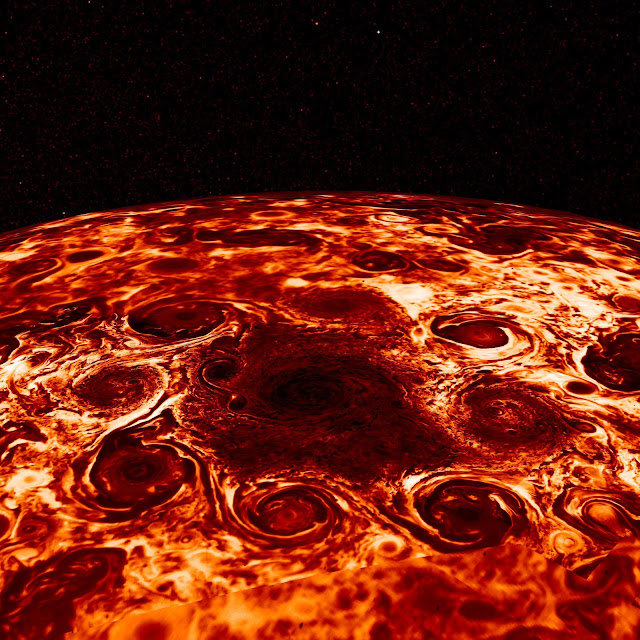
Jupiter's north pole seen by Juno spacecraft
Image
In this composite image, derived from data collected by the Jovian Infrared Auroral Mapper (JIRAM) instrument aboard NASA's Juno mission to Jupiter, shows the central cyclone at the planet's north pole and the eight cyclones that encircle it. JIRAM collects data in infrared, and the colors in this composite represent radiant heat: the yellow (thinner) clouds are about 9 degrees Fahrenheit (-13° Celsius) in brightness temperature and the dark red (thickest) are around -181 degrees Fahrenheit (-118.33° Celsius). Image Credit: NASA/JPL-Caltech/SwRI/ASI/INAF/JIRAM Explanation from: https://photojournal.jpl.nasa.gov/catalog/PIA22335
Exoplanet WASP-39b

Image
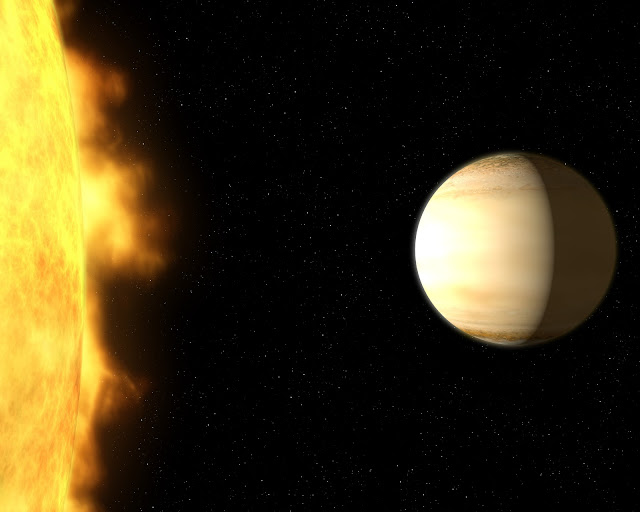
An international team of scientists has used the NASA/ESA Hubble Space Telescope to study the atmosphere of the hot exoplanet WASP-39b. By combining this new data with older data they created the most complete study yet of an exoplanet atmosphere. The atmospheric composition of WASP-39b hints that the formation processes of exoplanets can be very different from those of our own Solar System giants. Investigating exoplanet atmospheres can provide new insight into how and where planets form around a star. “We need to look outward to help us understand our own Solar System,” explains lead investigator Hannah Wakeford from the University of Exeter in the UK and the Space Telescope Science Institute in the USA. Therefore the British-American team combined the capabilities of the NASA/ESA Hubble Space Telescope with those of other ground- and space-based telescopes for a detailed study of the exoplanet WASP-39b. They have produced the most complete spectrum of an exoplanet’s atmosphere poss...

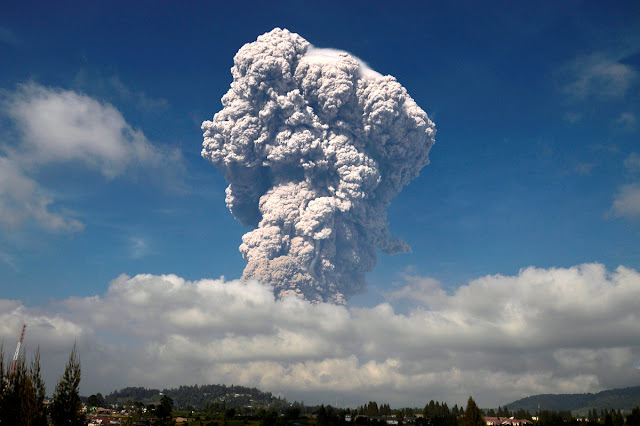
Mount Sinabung Volcano Eruption

Image
Berastagi, Sumatra, Indonesia February 19, 2018 Image Credit: Reuters

Dwarf Galaxy IC 4710

Image
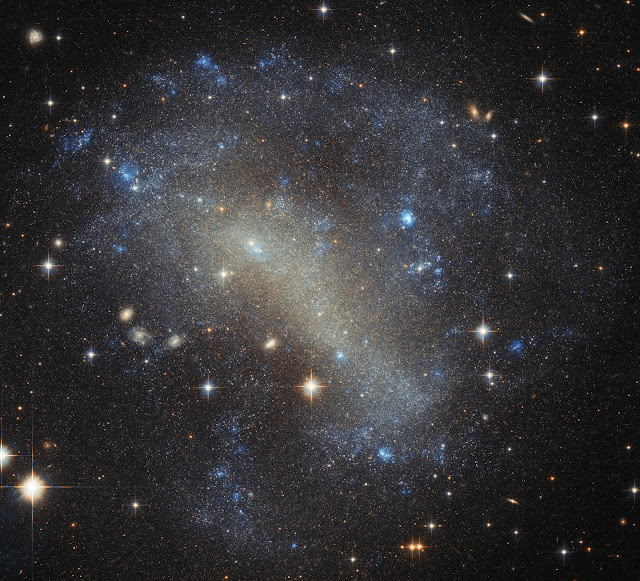
Discovered in 1900 by astronomer DeLisle Stewart and here imaged by the NASA/ESA Hubble Space Telescope, IC 4710 is an undeniably spectacular sight. The galaxy is a busy cloud of bright stars, with bright pockets — marking bursts of new star formation — scattered around its edges. IC 4710 is a dwarf irregular galaxy. As the name suggests, such galaxies are irregular and chaotic in appearance, lacking central bulges and spiral arms — they are distinctly different from spirals or ellipticals. It is thought that irregular galaxies may once have been spirals or ellipticals, but became distorted over time through external gravitational forces during interactions or mergers with other galaxies. Dwarf irregulars in particular are important to our overall understanding of galactic evolution, as they are thought to be similar to the first galaxies that formed in the Universe. IC 4710 lies roughly 25 million light-years away in the southern constellation of Pavo (The Peacock). This constellation...

Hawaii seen from the International Space Station

Image
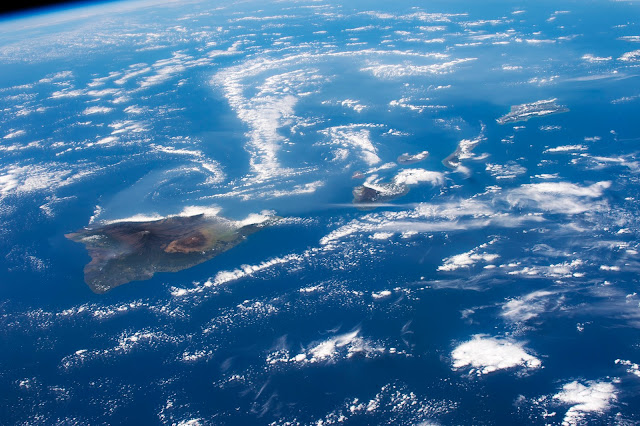
Crews aboard the International Space Station oriented the camera specifically to capture this panorama of Hawaii's Kilauea volcano (image left) with the long swirls of volcanic gases (top half of the image) wafting west from the volcano. Astronauts are trained to take oblique images of hard-to-see atmospheric haze by shooting obliquely to enhance visibility. The gas haze--termed vog, a combination of fog, smog and volcanic--is well known in Hawai'i, and is defined as "a form of air pollution that results when sulfur dioxide and other gases ... emitted by an erupting volcano react with oxygen and moisture in the presence of sunlight". Here the vog haze is transported hundreds of km downwind of the volcano (for scale the Big Island is 137 km, 85 miles, long). In this unusual view the vog forms a series of subtle but distinct alternating swirls (arrows) known as von Karman vortices, a favorite topic for crew photography. Swirls form under specific conditions of high atmo...

Protoplanetary Disk AS 209

Image
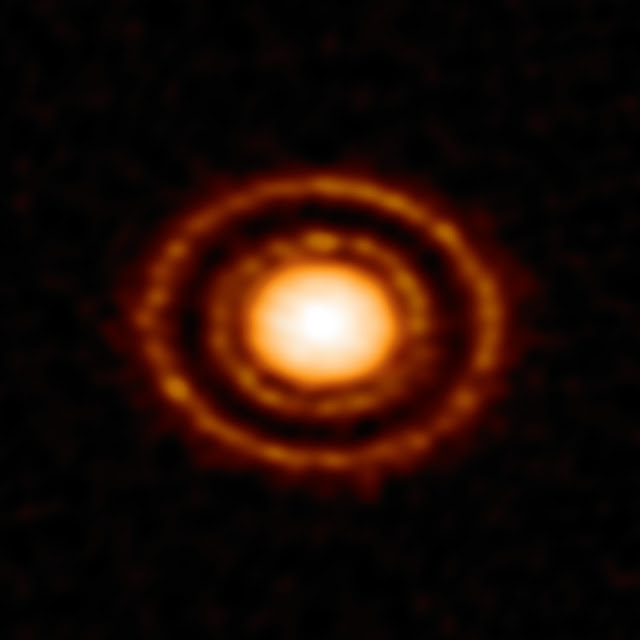
Nestled in the young Ophiuchus star-forming region, 410 light-years from the Sun, a fascinating protoplanetary disc named AS 209 is slowly being carved into shape. This wonderful image was captured using the high-resolution ALMA telescope, revealing a curious pattern of rings and gaps in the dust surrounding a young star. Protoplanetary discs are dense, rotating planes of gas and dust that surround newly formed stars; providing the matter that one day becomes orbiting planets, moons and other minor bodies. At less than one million years old, this system is very young, but already two clear gaps are being sculpted from the disc. The outer gap is deep, wide, and largely a dust-free zone, leading astronomers to believe that a giant planet almost the mass of Saturn is orbiting here — around 800 light-minutes from the central star, and more than three times the distance between Neptune and the Sun! As the planet carves out its path, dust piles up at the outer edge of its orbit, creating eve...

Spiral Galaxy NGC 3344

Image
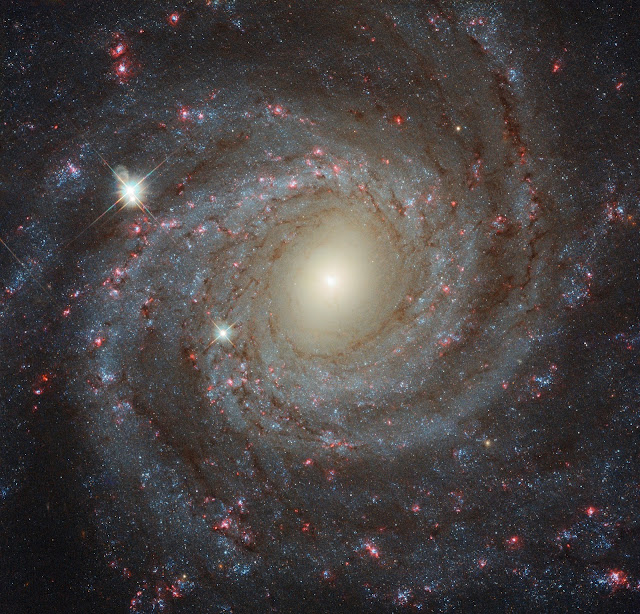
Captured by the NASA/ESA Hubble Space Telescope, the galaxy NGC 3344 presents itself face-on, allowing astronomers a detailed look at its intricate and elegant structure. And Hubble’s ability to observe objects over a wide range of different wavelengths reveals features that would otherwise remain invisible. Spiral galaxies are some of the most spectacular sights in the sky, but to an observer they do not all look the same. Some are seen edge-on, giving astronomers an excellent idea of the galaxy’s vertical structure; others are seen at an angle, providing a hint of the size and structure of the spiral arms; while others are seen face-on, showcasing their arms and bright core in all their beauty. Approximately 20 million light-years away in the constellation of Leo Minor (the Lion Cub), NGC 3344 is seen from a breathtaking face-on perspective. Half the size of the Milky Way, it is classified as a weakly barred spiral galaxy. The central bar is just visible in this image, taken with Hub...

Earth and Moon seen by OSIRIS-REx spacecraft from 63 million kilometers away

Image
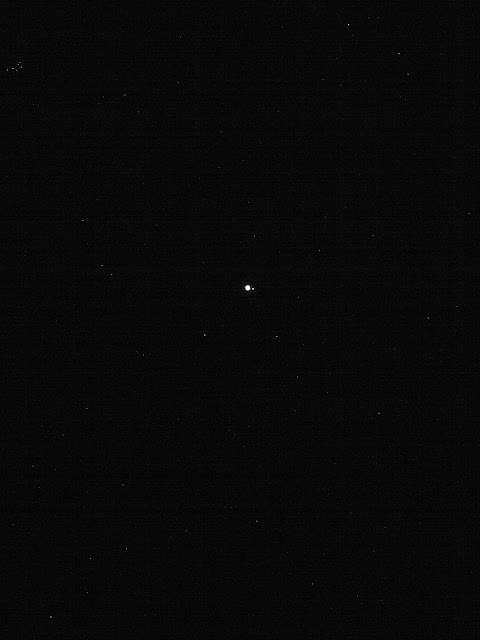
As part of an engineering test, NASA’s OSIRIS-REx spacecraft captured this image of the Earth and Moon using its NavCam1 imager on January 17 from a distance of 39.5 million miles (63.6 million km). When the camera acquired the image, the spacecraft was moving away from home at a speed of 19,000 miles per hour (8.5 kilometers per second). Earth is the largest, brightest spot in the center of the image, with the smaller, dimmer Moon appearing to the right. Several constellations are also visible in the surrounding space. The bright cluster of stars in the upper left corner is the Pleiades in the Taurus constellation. Hamal, the brightest star in Aries, is located in the upper right corner of the image. The Earth-Moon system is centered in the middle of five stars comprising the head of Cetus the Whale. NavCam1, a grayscale imager, is part of the TAGCAMS (Touch-And-Go Camera System) navigation camera suite. Malin Space Science Systems designed, built, and tested TAGCAMS; Lockheed Martin ...

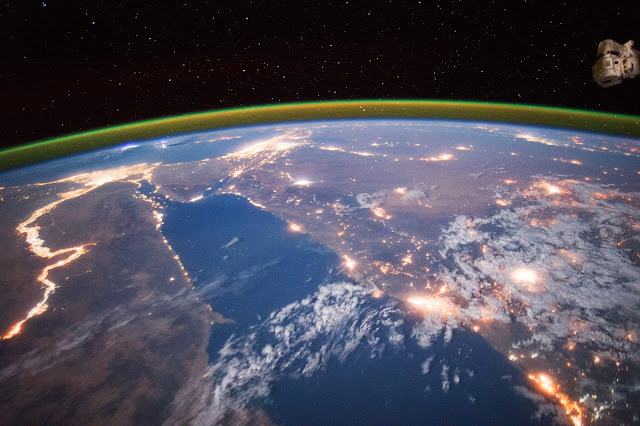
The Nile at Night seen from the International Space Station

Image
September 22, 2015 Image Credit: NASA

R Sculptoris

Image
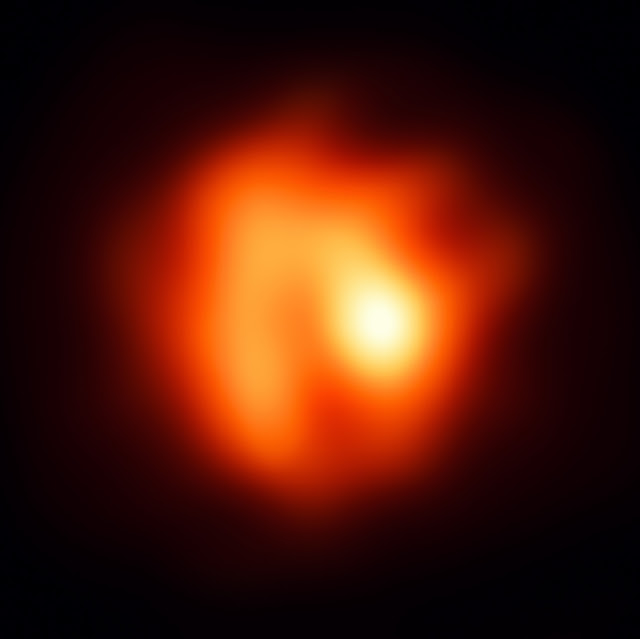
This ghostly image features a distant and pulsating red giant star known as R Sculptoris. Situated 1200 light-years away in the constellation of Sculptor, R Sculptoris is something known as a carbon-rich asymptotic giant branch (AGB) star, meaning that it is nearing the end of its life. At this stage, low- and intermediate-mass stars cool off, create extended atmospheres, and lose a lot of their mass — they are on their way to becoming spectacular planetary nebulae. While the basics of this mass-loss process are understood, astronomers are still investigating how it begins near the surface of the star. The amount of mass lost by a star actually has huge implications for its stellar evolution, altering its future, and leading to different types of planetary nebulae. As AGB stars end their lives as planetary nebulae, they produce a vast range of elements — including 50% of elements heavier than iron — which are then released into the Universe and used to make new stars, planets, moons, a...

Spiral Galaxy NGC 1559

Image
Roughly 50 million light-years away lies a somewhat overlooked little galaxy named NGC 1559. Pictured here by Hubble’s Wide Field Camera 3, this barred spiral lies in the little-observed southern constellation of Reticulum (The Reticule). NGC 1559 has massive spiral arms chock-full of star formation, and is receding from us at a speed of about 1300 km/s. The galaxy contains the mass of around ten billion Suns — while this may sound like a lot, that is almost 100 times less massive than the Milky Way. Although NGC 1559 appears to sit near one of our nearest neighbours in the sky — the Large Magellanic Cloud (LMC), this is just a trick of perspective. In reality, NGC 1559 is physically nowhere near the LMC in space — in fact, it truly is a loner, lacking the company of any nearby galaxies or membership of any galaxy cluster. Despite its lack of cosmic companions, when this lonely galaxy has a telescope pointed in its direction, it puts on quite a show! NGC 1559 has hosted a variety of sp...

Storm and Lightning over Petrified Forest National Park

Image
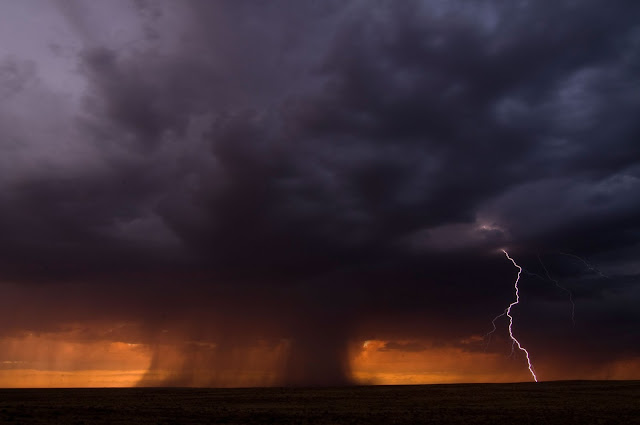
Navajo, Arizona Image Credit: Ralph Lauer, ZUMA Press/Corbis

Spotless Sun

Image
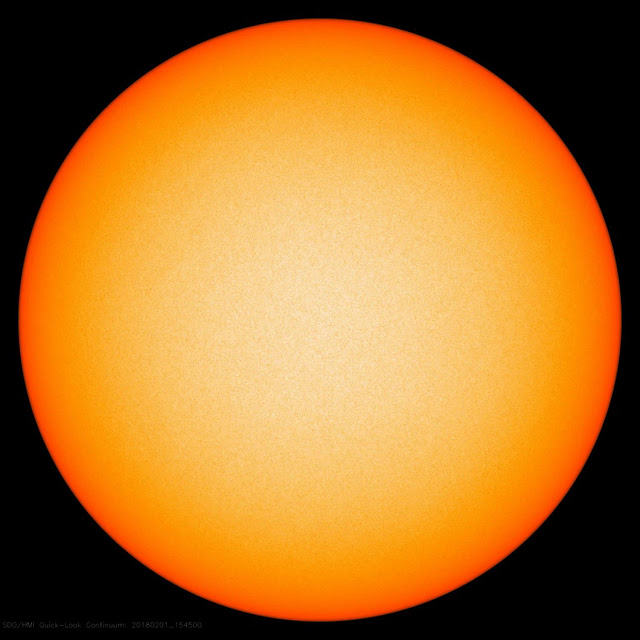
The Sun has had no sunspots for almost two weeks (as of February 1, 2018) and just has a single, tiny one that appeared on January 31, 2018. This spotless period is a prelude to the approaching period of solar minimum next year, when the Sun's activity will be at the low end of its 11-year cycle. Image Credit: NASA/GSFC/Solar Dynamics Observatory Explanation from: https://photojournal.jpl.nasa.gov/catalog/PIA22242

Rhea and Titan

Image
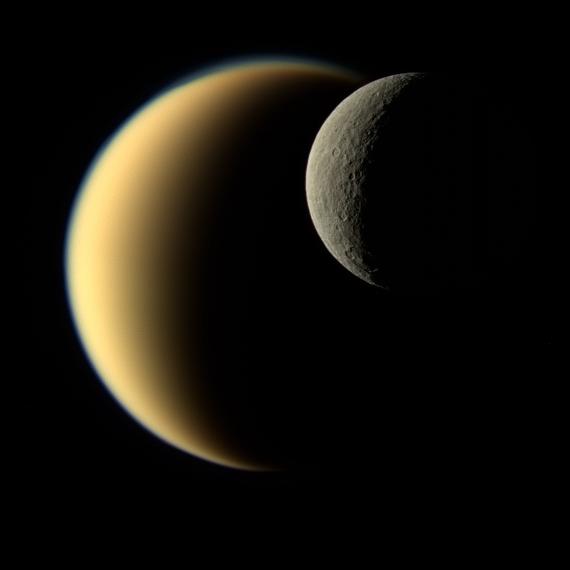
In this view, Saturn's icy moon Rhea passes in front of Titan as seen by NASA's Cassini spacecraft. Some of the differences between the two large moons are readily apparent. While Rhea is a heavily-cratered, airless world, Titan's nitrogen-rich atmosphere is even thicker than Earth's. This natural color image was taken in visible light with the Cassini narrow-angle camera on November 19, 2009, at a distance of approximately 713,300 miles (1,148,000 kilometers) from Rhea. The Cassini spacecraft ended its mission on September 15, 2017. Image Credit: NASA/JPL-Caltech/Space Science Institute Explanation from: https://photojournal.jpl.nasa.gov/catalog/PIA21904

TRAPPIST-1 Planets Probably Rich in Water

Image
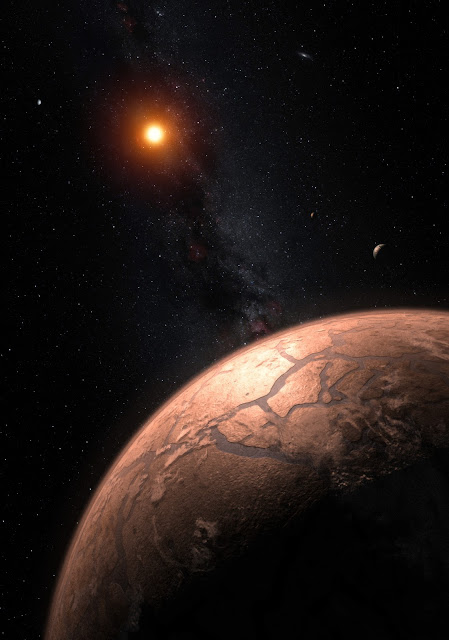
A new study has found that the seven planets orbiting the nearby ultra-cool dwarf star TRAPPIST-1 are all made mostly of rock, and some could potentially hold more water than Earth. The planets' densities, now known much more precisely than before, suggest that some of them could have up to 5 percent of their mass in the form of water — about 250 times more than Earth's oceans. The hotter planets closest to their parent star are likely to have dense steamy atmospheres and the more distant ones probably have icy surfaces. In terms of size, density and the amount of radiation it receives from its star, the fourth planet out is the most similar to Earth. It seems to be the rockiest planet of the seven, and has the potential to host liquid water. Planets around the faint red star TRAPPIST-1, just 40 light-years from Earth, were first detected by the TRAPPIST-South telescope at ESO’s La Silla Observatory in 2016. In the following year further observations from ground-based telescope...

Spiral Galaxy NGC 7331

Image
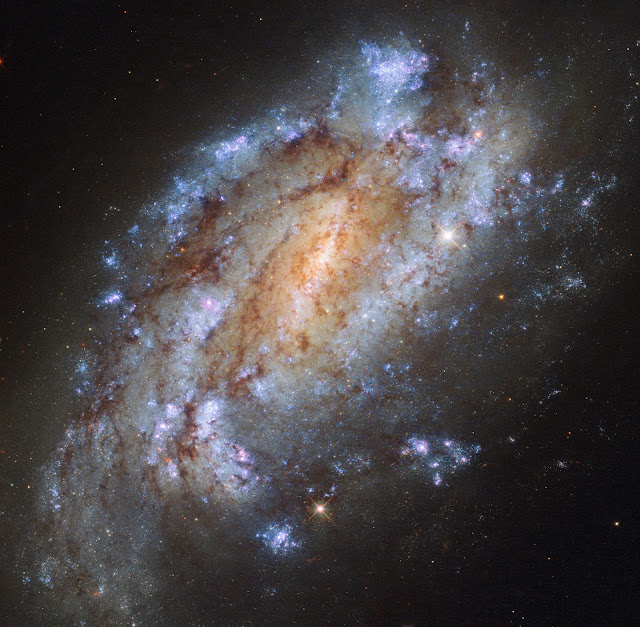
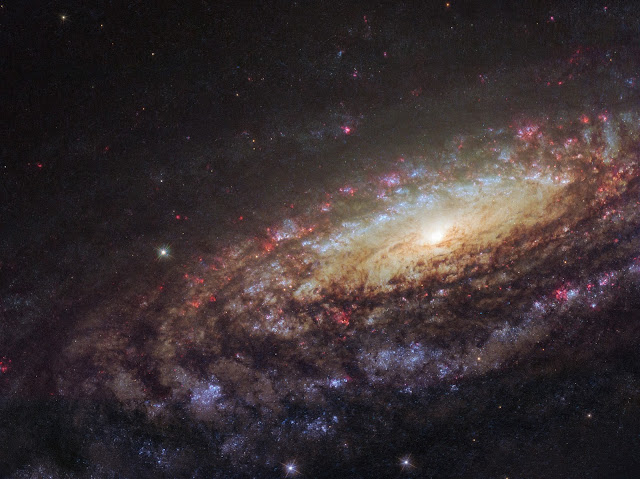
This NASA/ESA Hubble Space Telescope image shows a spiral galaxy known as NGC 7331. First spotted by the prolific galaxy hunter William Herschel in 1784, NGC 7331 is located about 45 million light-years away in the constellation of Pegasus (The Winged Horse). Facing us partially edge-on, the galaxy showcases it’s beautiful arms which swirl like a whirlpool around its bright central region. Astronomers took this image using Hubble’s Wide Field Camera 3 (WFC3), as they were observing an extraordinary exploding star — a supernova — which can still be faintly seen as a tiny red dot near the galaxy’s central yellow core. Named SN2014C, it rapidly evolved from a supernova containing very little Hydrogen to one that is Hydrogen-rich — in just one year. This rarely observed metamorphosis was luminous at high energies and provides unique insight into the poorly understood final phases of massive stars. NGC 7331 is similar in size, shape, and mass to the Milky Way. It also has a comparable star ...

Star-Forming Region Lupus 3

Image
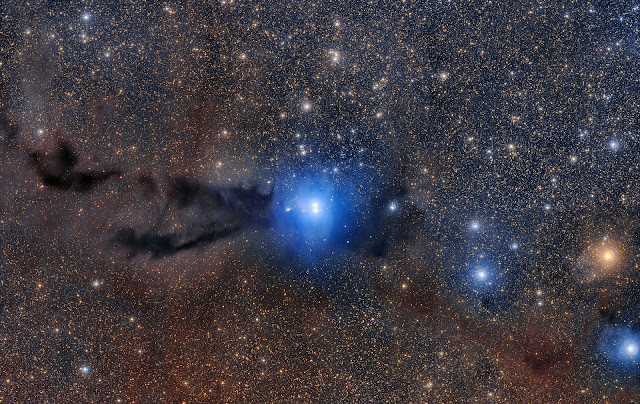
A dark cloud of cosmic dust snakes across this spectacular wide field image, illuminated by the brilliant light of new stars. This dense cloud is a star-forming region called Lupus 3, where dazzlingly hot stars are born from collapsing masses of gas and dust. This image was created from images taken using the VLT Survey Telescope and the MPG/ESO 2.2-metre telescope and is the most detailed image taken so far of this region. The Lupus 3 star forming region lies within the constellation of Scorpius (The Scorpion), only 600 light-years away from Earth. It is part of a larger complex called the Lupus Clouds, which takes its name from the adjacent constellation of Lupus (The Wolf). The clouds resemble smoke billowing across a background of millions of stars, but in fact these clouds are a dark nebula. Nebulae are great swathes of gas and dust strung out between the stars, sometimes stretching out over hundreds of light-years. While many nebulae are spectacularly illuminated by the intense r...

Havasu Falls

Image
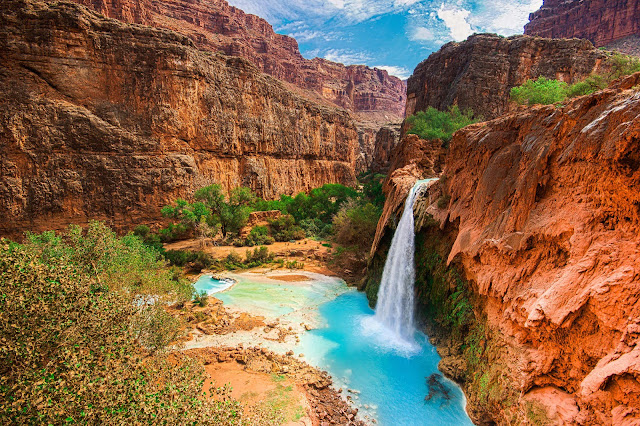
Havasu Falls is a waterfall of Havasu Creek, located in the Grand Canyon, Arizona, United States. It is within Havasupai tribal lands. Havasu Falls is located 1 1⁄2 miles (2.4 km) from Supai. It is the more famous and most visited of the various falls along Havasu Creek. It consists of one main chute that drops over a 90-to-100-foot (27 to 30 m) vertical cliff into a series of plunge pools. High calcium carbonate concentration in the water creates the vivid blue-green color and forms the natural travertine dams that occur in various places near the falls. Due to the effects of flash floods, the appearance of Havasu Falls and its plunge pools has changed many times. Prior to the flood of 1910, water flowed in a near continuous sheet, and was known as Bridal Veil Falls. The notch through which water flows first appeared in 1910, and has changed several times since. Water currently flows as one stream. In the past, there were sometimes multiple streams, or a continuous flow over the edge....

Globular Cluster NGC 3201

Image
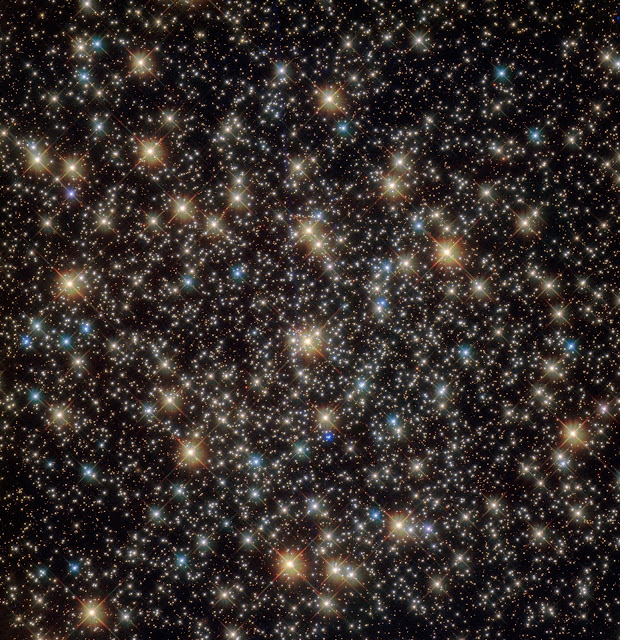
This image from the NASA/ESA Hubble Space Telescope reveals a glistening and ancient globular cluster named NGC 3201 — a gathering of hundreds of thousands of stars bound together by gravity. NGC 3201 was discovered in 1826 by the Scottish astronomer James Dunlop, who described it as a “pretty large, pretty bright” object that becomes “rather irregular” towards its centre. Globular clusters are found around all large galaxies, but their origin and role in galaxy formation remain tantalisingly unclear. Astronomers recently discovered a black hole lurking at the heart of NGC 3201 — its position was revealed by the strange movements of a star being quickly flung around a massive, invisible counterpart. This sparkling group of stars also has some strange properties which make it unique amongst the over 150 globular clusters belonging to the Milky Way. NGC 3201 has an extremely fast velocity with respect to the Sun and its orbit is retrograde, meaning that it moves speedily in the opposite ...

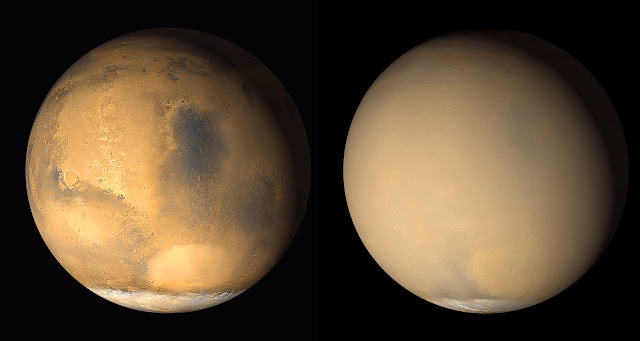
Great Dust Storms on Mars

Image
Two 2001 images from the Mars Orbiter Camera on NASA's Mars Global Surveyor orbiter show a dramatic change in the planet's appearance when haze raised by dust-storm activity in the south became globally distributed. At left, an image from late June 2001 shows clear conditions over much of the planet, with regional dust-storm activity occurring in the Hellas basin (bright oval feature) near the edge of the south polar cap. At right, a July 2001 image from the same perspective shows the planet almost completely enveloped. Dust extends to altitudes of more than 60 kilometers (37 miles) during global-scale storms. Although dust storms occur year-round on Mars, they often occur in greater numbers during certain seasons. In particular, it has long been known from Earth-based telescopic observations that the largest, global dust events(those that enshroud the entire planet) occur during the southern spring and summer. As the Mars Global Surveyor (MGS) mission began to monitor this per...